Hall of Fame

All Award Winners

In the Hall of Fame, you will find all award winners who have been honoured with an OPER! AWARD — artists, opera houses, productions and personalities recognised for excellence and exceptional achievements.

Best Opera House

Bestes Opernhaus / Best Opera House – Theater Regensburg, Sebastian Ritschel © Sylvain Guillot

Bestes Opernhaus / Best Opera House – Theater Regensburg, Sebastian Ritschel © Sylvain Guillot

More of the new, less of the familiar, embracing openness instead of programmatic caution, and an unshakable belief in the right of musical theatre to exist in all its forms, colours, and varieties: under its artistic director Sebastian Ritschel, the Theater Regensburg shows great readiness to take risks, but it can boast a high rate of success. Top quality results in high audience numbers, in trust and approval — regionally and, for quite some time now, nationwide as well. The call for a broader repertoire is often heard, yet rarely answered — not so in Regensburg, where it is common practice! And always inspiring, too, thanks to an outstanding ensemble. Innovations with regard to participation, accessibility, community building and sustainability demonstrate further how a theatre must indispensably anchor itself within civic society. There can be no question: the best opera house is found under the roof of the Theatre — soon: State Theatre — Regensburg!

Bestes Opernhaus / Best Opera House: Théâtre Royal de la Monnaie, Brussels. © Simon Van Rompay

Bestes Opernhaus / Best Opera House: Théâtre Royal de la Monnaie, Brussels. © Simon Van Rompay

The Théâtre Royal de la Monnaie / De Munt, under its general and artistic director Peter de Caluwe, radiates enormous appeal and inviting openness, encouraging artists to creative top performances and drawing in audiences. Its programming and the sophistication and aesthetics of its productions regularly set standards, while making opera accessible to younger generations as well. Its activities are, at the same time, embedded within a comprehensive mission to be a modern opera house able to reach out to society, affirming the values of sustainability and a culture of welcome. For almost 20 years and now in his last season, Peter de Caluwe has been leading La Monnaie / De Munt at a consistently high level and with undiminished creativity — setting an exceptional record in the international opera business and worthy of an award. No question: the best opera house is in Brussels — La Monnaie / De Munt!

Bestes Opernhaus / Best Opera Company: Dutch National Opera

Bestes Opernhaus / Best Opera Company: Dutch National Opera

The Dutch National Opera under its director Sophie de Lint shows in an exemplary way how an opera house can be relevant and win acceptance in a diverse, modern urban society. Sophisticated projects and the right approach bring together people from different origins, backgrounds and interests under the common roof of the house on Waterlooplein. At the same time, its core identity as an opera house remains at the forefront of programming and perception, anchoring the art form in the future. The excellent selection of artists and their fitting combinations for a wide-ranging canon of rarities, classics and impactful world premieres turns every new production into a true experience of special artistic interest. The Dutch National Opera is a house for its city and at the same time an indispensable player in the international opera business.

OPER! AWARDS 2023, Juror Uwe Friedrich mit Preisträger Heribert Germeshausen (Intendant Oper Dortmund)

OPER! AWARDS 2023, Juror Uwe Friedrich mit Preisträger Heribert Germeshausen (Intendant Oper Dortmund)

The Oper Dortmund under its intendant Heribert Germeshausen has opened itself in an exemplary manner towards the town’s civic society through innovative formats such as We DO Opera!, at the same time making itself a subject of interest and a destination for national and international opera professionals and enthusiasts alike. Intelligent programming that includes rarities as well as opera staples, the engagement of exceptional singers and the Wagner-Kosmos symposium, which is unique in this form, have made the Oper Dortmund a must-go in 2022 for everybody with an interest in opera.

It took Laura Berman, the new director, no time at all to put the Hanover State Opera on of the musical map as one the most interesting houses. Which is not to say that the proud building by Georg Ludwig Friedrich Laves and its cultural inner life had ever disappeared from it. But Berman runs the place without egocentric vanities, putting on performances for the whole town, relying not on supposedly big names but on high-quality titles as well as high-quality directors. And if the musical quality, too, is as convincing as it was for the opening night of Halévy’s La Juive you’re all but guaranteed attention well beyond the region.

Bestes Opernhaus. Intendant Andreas Homoki, Jury-Vorsitzender Ulrich Ruhnke. Fotograf: Manfred Vogel

Bestes Opernhaus. Intendant Andreas Homoki, Jury-Vorsitzender Ulrich Ruhnke. Fotograf: Manfred Vogel

Nur wenige Opernhäuser ermöglichen ihrem Publikum den Zugang zum Werkkatalog der Kunstgattung Oper in seiner nahezu ganzen bewundernswerten Breite und Vielfalt wie das Opernhaus Zürich. Repertoireverbote wie anderswo gibt es hier nicht. Die hervorragende Spielplangestaltung der Saison 2018/19 war gekrönt durch eine Vielzahl von szenisch, musikalisch wie sängerisch besonders geglückten Produktionen. Eine exzellente Bilanz! Der Spürsinn des Intendanten für neue, innovative Regisseure, die Verpflichtung der Besten der Etablierten und die durchgängig hochkarätigen Sängerbesetzungen mit spannenden Debüts machen das Opernhaus Zürich unter Andreas Homoki zur lohnendsten Adresse.

Best Female Singer

Beste Sängerin / Best Female Singer – Miina-Liisa Värelä (erkrankt, den Preis nahm stellvertretend Katharina Wagner von den Bayreuther Festspielen entgegen. Wir danken Catherine Foster für ihr spontane Übernahme der musikalischen Darbietung) © Sylvain Guillot

Beste Sängerin / Best Female Singer – Miina-Liisa Värelä (erkrankt, den Preis nahm stellvertretend Katharina Wagner von den Bayreuther Festspielen entgegen. Wir danken Catherine Foster für ihr spontane Übernahme der musikalischen Darbietung) © Sylvain Guillot

Eight years ago, a new star rose in the Wagnerian heavens over the island of Funen. At first, only a few aficionados noticed, but they were absolutely ecstatic, raving about her warm low register, lyrical phrasing and dramatic colours: an ideal Sieglinde — role debut of a then 35-year-old soprano from Helsinki in a Danish Ring production. Back home, she had already drawn attention as Senta and Elsa, but it was now that her international career rapidly took off. Soon, she debuted as Isolde in Glyndebourne and as Ortrud in Bayreuth; Petrenko brought her to Baden-Baden and Thielemann to Dresden. Last autumn in Rome, this unique Hochdramatische sang the Walküre-Brünnhilde for the first time — a role she will soon perform in Munich as well. Our “Female Singer of the Year”: Miina-Liisa Värelä.

Beste Sängerin / Best Female Singer: Corinne Winters. © Simon Van Rompay

Beste Sängerin / Best Female Singer: Corinne Winters. © Simon Van Rompay

Some works or projects require extreme transformations: from childlike, young woman in love to raging fury, avenger, murderer or madwoman. How lucky when there are singer-performers who are vocally and physically up to these roller coaster rides, who can sweep the audience away and make all these emotions comprehensible! This was the case in July in Aix-en-Provence at the Gluck double premiere of Iphigénie en Aulide and Iphigénie en Tauride. Tenderness, vulnerability, strength and toughness — our female singer of the year combines all of this in an outstanding way in her nuanced and flawlessly sung role portraits. Whether in French, Czech or Italian — she is always sensational: the exceptional soprano Corinne Winters.

Beste Sängerin / Best Female Singer: Ermonela Jaho

Beste Sängerin / Best Female Singer: Ermonela Jaho

It is well known that an opera career requires more than just a beautiful voice. Still, it is rare that an artist is willing to reveal their innermost being to the audience through their singing and their acting alike. The enormous power in Giacomo Puccini’s melodies, the abysses within the most delicate cantilenas can only be experienced through the artistry of someone embracing a character’s conflicts, their weaknesses and longings with great honesty. In Zurich in 2023, Puccini’s La rondine became a moving and exhilarating night at the opera with enormous depth thanks to Ermonela Jaho as a brilliant Magda: a trilling swallow and a dying swan all in one.

Virtually overnight, since her covering of Les Huguenots in Paris 2018, she has changed the opera landscape. The US soprano Lisette Oropesa has brought her own lightness, even gracefulness to it, but most of all an unheard-of aromatic, stylistically flexible sound. She lends dynamism to the romantic repertoire with an easy hand, but also fleshes out baroque music. At the Salzburg Festival last year, she was an agile Lucia di Lammermoor, still affable even in her madness. In London, she gave a magnetising Alcina and, on CD, an unexpectedly dramatic, yet fruity Theodora.

Anita Rachvelishvili, the mezzo-soprano from Georgia, possesses and wields one of the greatest operatic voices for some decades. Larger than life, for her first CD she had to stand behind the orchestra so as not to drown out everything else. Yet Rachvelishvili knows how to downsize that voice, too, tracing out even the most delicate notes. She is self-confessedly old-school, upholding that ancient proverb: “There’s no school, but old school.” She is most likely the most important Carmen since Grace Bumbry and Agnes Baltsa. And the best Amneris since Fedora Barbieri. If the operatic mezzo is a thing again, it’s because of her!

Mozart war ihr Fundament. Und sie ist klug genug, noch immer regelmäßig zu diesem zurückzukehren. Vom Typus her verkörpert Joyce DiDonato eine burschikosere — und damit moderne Kategorie von Sängern. Vorbildlich setzt sie sich auch für neuere Musik ein, so etwa für den Komponisten Jake Heggie. Und meistert so den enormen Spagat zwischen Barock, Romantik und Gegenwart. Sie ist die Mezzo-Diva des 21. Jahrhunderts. Was sie auf beeindruckende Art auch mit ihrer Dido in der monumentalen Aufführung von Berlioz’ Trojanern an der Wiener Staatsoper unter Beweis gestellt hat.

Best Male Singer

Bester Sänger / Best Male Singer – Jonathan Tetelman © Sylvain Guillot

Bester Sänger / Best Male Singer – Jonathan Tetelman © Sylvain Guillot

A powerful volume and a zest for conquest, high Cs and base instincts: our Male Singer of the Year has achieved world fame with his verismo roles. He himself describes the joy of throwing himself into those high notes — which he masters more magnificently than any other contemporary tenor — as being like “hurling yourself from a mountain peak onto the ski slopes”. Apparently, they are even addictive, or so he claims. On the heels of successes with Puccini, Giordano and Zandonai, he has recently refined his approach quite significantly, now also mastering more lyrical roles such as Werther and Don Carlo. The international stages have become his home, and he is currently singing his first French Faust at the Bavarian State Opera. The “Best Male Singer” of the year is: Jonathan Tetelman.

Bester Sänger / Best Male Singer: Klaus-Florian Vogt. © Simon Van Rompay

Bester Sänger / Best Male Singer: Klaus-Florian Vogt. © Simon Van Rompay

He is the Wagner tenor with the brightest, and in that way most radiant voice, too, of all time. His Wagner heroes look slimmer, in a sense more athletic than ever. And yet, he is not just a simple daredevil. After many years as the “perpetual” Lohengrin, he has worked his way through Parsifal, Stolzing, Tannhäuser, Siegmund and Tristan to Siegfried in the last two parts of the Ring of the Nibelung — two roles with which he made his stage debut at the Zurich Opera and which he also sang at the Bayreuth Festival last year. He is proof that after eons there is still something new to be discovered in the Wagner universe: Klaus Florian Vogt.

Bester Sänger / Best Singer: Michael Spyres

Bester Sänger / Best Singer: Michael Spyres

Michael Spyres’ voice has metallic power, slenderness, freshness and a sandblast-like softness: it is absolutely unique among today’s tenors. Hardly any singer before him has shown that Hector Berlioz’ tenor parts require their own specific type of voice. And that it is possible to build a career on roles like Faust, Benvenuto Cellini and Énée in Les Troyens. Michael Spyres has now reached a dramatic intensity that is sometimes reminiscent of Jon Vickers — enough to tackle parts such as Lohengrin. A unique path.

In the eye of the tornado that was Dmitri Tcherniakov’s new Ring des Nibelungen for Berlin, one singer in particular seemed to flourish and get fully into his stride. The German baritone Michael Volle has been a leading Holländer, Hans Sachs and Wotan for years. With infinite reserves, he even discovers lyrical elements in his roles, following in the footsteps of great singers of the past such as Hans Hotter, Rudolf Bockelmann and Hermann Uhde. Not neglecting the Italian repertoire has benefitted his colour palette. Michael Volle currently shows himself at the Wagner zenith of his prowess.

Benjamin Bernheim is French, grew up and trained in Switzerland, reached artistic maturity as a member of the Zurich Opera ensemble, then sharpened his profile with some smaller tenor parts in Salzburg. For the past two years the international career of the mid-thirties singer has really been taking off. His French repertoire is, as they say at home, formidable — underpinned by his lyrical voice, so strong in the high register, by his sensitive treatment of language as well as his metallic punch and a technically accomplished voix mixte. His forte at the moment are Gounod’s Faust, enchantingly beautiful on a recording of the original version for Palazzetto Bru Zane, and Massenet’s Des Grieux — both are sophisticated revelations!

Als Lohengrin, letztes Jahr in Bayreuth und zuvor schon an der Semperoper Dresden, hat er den womöglich größten, jedenfalls erstaunlichsten Schritt in seiner Karriere vollzogen: vom lyrischen Tenor zum vielleicht lyrischsten Heldentenor aller Zeiten. Piotr Beczała war immer ein Künstler im allerobersten Segment internationaler Opernsänger – ein Tenor in der indirekten Nachfolge von Jan Kiepura. Durch seinen Bayreuther Lohengrin ist er Kult geworden.

Best Conductor

Bester Dirigent / Best Conductor – Gianluca Capuano © Sylvain Guillot

Bester Dirigent / Best Conductor – Gianluca Capuano © Sylvain Guillot

An Italian conductor who – in addition to organ, composition and conducting – also studied philosophy in Freiburg is a rarity in itself. For several years now, he has been surprising the classical music world both as the leader of his own vocal ensemble, Il Canto di Orfeo, and as the chief conductor of Les Musiciens du Prince — Monaco with outstanding, historically informed interpretations. In 2025, he delivered a compelling first at the Opéra de Monte-Carlo, a performance of Richard Wagner’s Das Rheingold that combined authentic orchestral sound, textual clarity and a keen sense for vocal lines. It was followed by another sensation at the Salzburg Whitsun Festival with Hotel Metamorphosis — a new opera pasticcio by director Barrie Kosky, consisting of compositions by Antonio Vivaldi, for which our “Conductor of the Year” acted as lead curator: Gianluca Capuano.

Bester Dirigent / Best Conductor: Pablo Heras-Casado. © Simon Van Rompay

Bester Dirigent / Best Conductor: Pablo Heras-Casado. © Simon Van Rompay

It is, in fact, a conductor’s job to organize time, sensibly — something often overlooked in the age of influencers. One of the few greats in his field without a permanent orchestra, in demand worldwide, still upholding this aspect of craftsmanship. He has never been a specialist, even if he was mistakenly thought to be one. Rather: a libero, with enormous musical-rhetorical versatility. He enjoys a significant profile in both historically informed performance and contemporary music, both in the opera pit and on the concert podium; well-versed in the German as well as in the Italian, French and Spanish repertoire, he has recently released the recording of his brilliant 2024 Bayreuth debut with Parsifal and is currently working in Paris on his second Ring production: the unique, the cool, clear-headed and sensual Pablo Heras-Casado.

Anyone growing up as a child of opera singers, playing the piano, cello and bassoon and being blessed with an extraordinary vocal instrument in their throat should possibly be regarded as more than abundantly gifted by God. But anyone hearing so many voices singing within themselves, loving music in all its forms will also be destined to conduct. As an established singer, it takes a lot of perseverance to assert yourself internationally in front of well-known orchestras, but Nathalie Stutzmann has that perseverance in spades. Her outstanding debut 2023 in the pit of the Bayreuth Festival Hall with Richard Wagner’s highly charged Tannhäuser greatly deserves the OPER! AWARD for Best Conductor.

The intendant and stage director Andreas Homoki had asked him to take on his new Ring des Nibelungen for Zurich. At first, Gianandrea Noseda was not keen, yet eventually he changed his mind. Luckily! For Noseda has thrilled audiences and critics alike with his fresh take on the monumental score. Under his baton, Wagner’s “patriotic belcanto” is more than a mere statement of intent, it becomes bright sound and sung narrative. Noseda has long been well-known as a master of the Italian opera repertoire and a good hand at French and Russian. Now, in Zurich, he has shown himself to be a Wagner adept as well.

Her workload until the first theatre lockdown in spring was considerable. As the outgoing music director in Graz, Oksana Lyniv prepared Weinberg’s The Passenger, gave her debut at the Berlin State Opera with Cherubini’s Medea and conducted the extraordinarily carefully analysed Bartók twin-premiere at the Bavarian State Opera. Unsparing but empathic, with the Bavarian State Orchestra she shaped a gripping interpretation of the sorrowful and unfathomable music of the Hungarian composer. This outstanding conductor delivers — with seriousness, vigour and precision.

Am Theater Erfurt brachte sie mit straffer Hand, glasklarer Schlagtechnik und bemerkenswertem Stilwillen das städtische Orchester auf Vordermann, mittlerweile ist sie die Generalmusikdirektorin am Staatstheater Nürnberg. Selbstverständlich wird bei Joana Mallwitz immer wieder auch ihr Geschlecht erwähnt, Dirigentin, Generalmusikdirektorin, Zeugin einer neuen Zeit auf dem Dirigentinnenpult. Aber sie braucht diesen Hinweis gar nicht, braucht keinen Bonus, weil sie ein Mensch ist, der akribisch dafür arbeitet, dass alle gemeinsam am Abend im Opernhaus das Beste auf die Bühne bringen.

Best Director

Bester Regisseur / Best Director – Barrie Kosky © Sylvain Guillot

Bester Regisseur / Best Director – Barrie Kosky © Sylvain Guillot

He is a director whose work is always very good, and frequently fantastic. This time, he did even more than just direct: he played a decisive role in developing the plot of a cleverly executed “instant opera” that channelled the melodic genius of Antonio Vivaldi into a modern, dramatised and philosophically seasoned narrative based on Ovid’s mythological classics — all set within a transitory, temporary space. The audiences at the Salzburg Whitsun Festival enthusiastically accepted his invitation to the Hotel Metamorphosis, where he allowed four wonderful singer personalities to shine. For this reason, the OPER! AWARDS “Director of the Year” is the one and only: Barrie Kosky.

Bester Regisseur / Best Director: Tobias Kratzer. © Simon Van Rompay

Bester Regisseur / Best Director: Tobias Kratzer. © Simon Van Rompay

He is currently on a roll: all four of his opera productions in 2024 were hits. At the Bavarian State Opera, he told Weinberg’s The Passenger as a cruise ship drama tinged with nightmare surrealism. Richard Wagner’s Rheingold at the same house was a visually powerful reflection on the all-too-human element in religion. Liebesgesang at the Bühnen Bern offered a shocking look at people in extreme situations. At the Deutsche Oper Berlin, he discovered the beleaguered woman behind the shrew in Richard Strauss’ Intermezzo. He succeeds in doing things in a surprising, clever, multi-layered way, convincing with details, wit and precise character development. The award for best director therefore goes to the future artistic director of the Hamburg State Opera: Tobias Kratzer.

© Michel Schnater. Manuel Brug, Mitglied der Jury, und Lydia Steier - BESTE REGISSEURIN

Beste Regisseurin / Best Director: Lydia Steier © Michel Schnater

The American Lydia Steier, who lives in Germany, has become one of the most important opera directors in recent years. Back in 2016, she caused a sensation in Basel with her idiosyncratic interpretation of Stockhausen’s Donnerstag aus Licht. In 2023, in Verdi’s Don Carlos at the Grand Théâtre de Genève, she captivatingly showed the eternal, inhumane mechanisms of the surveillance state. It was an enthralling night, excellently done. Her Frankfurt Aida faced the big shadow of Hans Neuenfels, while not long ago in Vienna she went searching for the best of all possible Candide worlds.

OPER! AWARDS 2023, Juror Manuel Brug mit Preisträger Claus Guth

OPER! AWARDS 2023, Juror Manuel Brug mit Preisträger Claus Guth

Claus Guth has got a recognisable style and is much in demand at home and internationally. With that kind of success comes the risk of repetitiveness. Yet in 2022 he realised four entirely original productions: a surreal Makropulos Affair at the Berlin State Opera, where Emilia Marty retires to an ice chamber for her convalescence as one of the undead. After that, a simple, atmospheric, politically and emotionally charged Don Carlo as a Verdi feast in Naples. Guth then showed a particularly keen hand at two contemporary pieces: his dark and chilly Bluthaus by Georg Friedrich Haas that kept turning the emotional screws at the Cuvilliés Theatre in Munich, and the world premiere of Pascal Dusapin’s Il viaggio, Dante in Aix-en-Provence, which he dressed up as subversive revue theatre.

It’s exactly what musical theatre needs these days, and urgently so: clever, thoughtful, yet entertaining interpretations. Tobias Kratzer and his set and costume team tick all these boxes perfectly. Why? Because he’s hardworking, original, hands-on and always ready to surprise. Because he knows his craft, though without putting on nerdy airs and graces, and because he’s fully committed to the present. He knows how to dress the old lady opera in dignified yet meaningful new outfits, up-to-date, aware of today’s topics and visual culture – whether its Verdi’s Forza del destino in Frankfurt, Tannhäuser in Bayreuth, Guillaume Tell in Lyon or Fidelio in London.

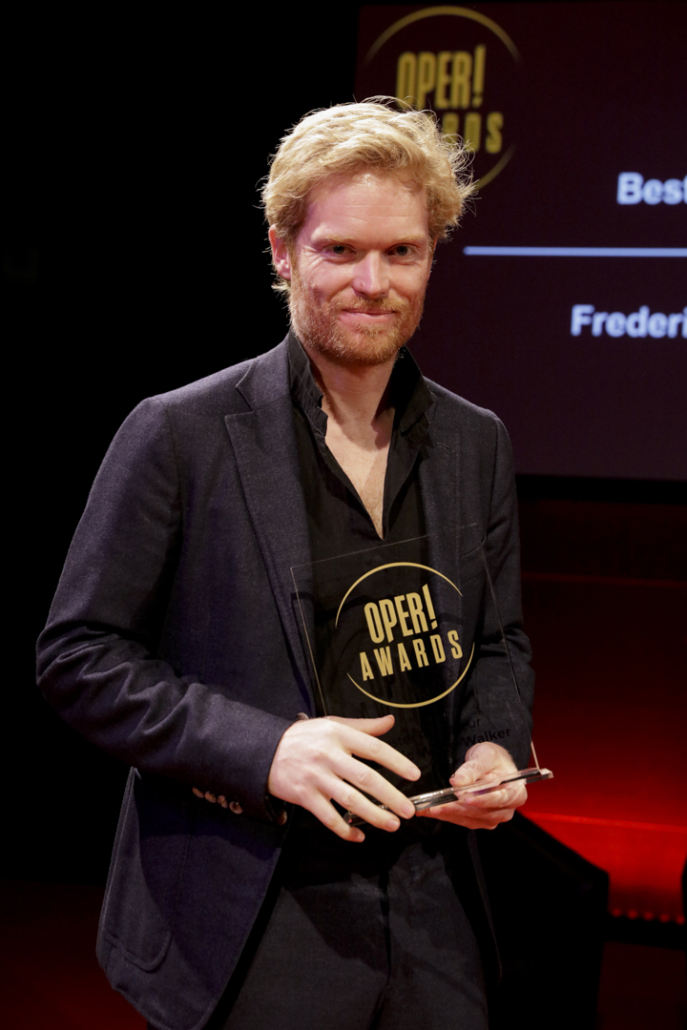
Bester Regisseur / Best Director: Frederic Wake-Walker

Bester Regisseur / Best Director: Frederic Wake-Walker

Frederic Wake-Walker ist Regisseur, Produzent und Kurator von Opern und multidisziplinären Künsten. Er arbeitet modern, aber nicht bilderstürmerisch: Bei ihm erkennt man die Stücke wieder, aber man erkennt immer auch, wie sehr er sich Gedanken macht, sie im Hier und Heute zu verankern, selbst wenn er sie scheinbar historisch ausstatten lässt. Eine witzig-sprudelnde Ariadne auf Naxos an der Mailänder Scala und ein ergreifend einfacher Peter Grimes an der Oper Köln sind dafür eindrückliche Beweise.

Best Orchestra

Bester Orchester / Best Orchestra – Staatskapelle Berlin © Sylvain Guillot

Bester Orchester / Best Orchestra – Staatskapelle Berlin © Sylvain Guillot

So they did make the right choice in the end! After the Orchestra of the Year achieved world-class status under the decades-long guidance of an exceptionally prominent and commanding maestro, the decision to choose a German conducting superstar as his successor seemed rather controversial, even risky. Could it really work? Nearly the entire industry predicted trouble. However, performances of Wagner and Strauss in the early stages of this new partnership have been so convincing, showing the former “Premier Orchestra of East Berlin” in such glorious new form, that it simply has to be said out loud — for the revival of an astonishing The Silent Woman by Richard Strauss at the Berlin State Opera, the “Orchestra of the Year” award goes to: the Staatskapelle Berlin.

Bestes Orchester und Bester Chor / Best Orchestra and Best Choir: Ensemble Pygmalion, here Raphaël Pichon. © Simon Van Rompay

Bestes Orchester und Bester Chor / Best Orchestra and Best Choir: Ensemble Pygmalion, here Raphaël Pichon. © Simon Van Rompay

Any conductor aiming to create new sound worlds is well-advised to set up their own orchestra and choir, allowing them the freedom to bring to life new art as well as old. That makes the ancient Greek artist, who fell in love with his own work, an excellent choice as patron saint and namesake. Since 2006, Raphaël Pichon and his ensembles have enriched the historically informed performance of baroque, classical and romantic works and created new pieces through reconstruction, collage or combination. A very special kind of musical experience was the 2024 premiere of the opera event Samson in Aix-en-Provence with music by Rameau, to whom our orchestra and choir of the year are closely linked by their name: Pygmalion.

© Milan Gino. Andre Comploi vom Teatro alla Scala - BESTES ORCHESTER

Even Donizetti experts were surprised by the dark colours that the Orchestra of La Scala discovered with Riccardo Chailly in Lucia di Lammermoor — this was bel canto not as a star vehicle with a bit of humble accompaniment, but as a profound social drama driven by the orchestra itself. The sensual sounds in the premiere of Kurtág’s Fin de partie are unforgettable, too. Whether Montemezzi’s L’amore dei tre re not long ago or the monumental German repertoire: the orchestra always plays from within the Italian musical tradition, that is to say: with the possibilities of the human voice in mind.

OPER! AWARDS 2023, Juror Björn Woll mit Eva-Maria Tomasi von den Berliner Philharmonikern

OPER! AWARDS 2023, Juror Björn Woll mit Eva-Maria Tomasi von den Berliner Philharmonikern

No orchestra, no opera! It provides the musical basis for the singers and enables the effective blossoming of their voices. And what a noble sound carpet the Berlin Philharmonic rolled out for Tchaikovsky’s Queen of Spades: an animated, spontaneous and fresh exegesis of the score! Vividly drawn and pure of style the sounds, at times luxuriously beautiful, at times brusque and hard, evoked by an orchestra that managed to be dazzling and intimate in equal measure. Its musicians teased out every small detail of this miracle of a musical score.

31 cancellations since April 2020, not a single opera performance — but then, on 1 August a resounding, exemplary reunion: the Elektra premiere at the Salzburg Festival, conducted by Franz Welser-Möst. What power, what a signal to an opera world that had been gagged for months! Consistently Covid-tested, the musicians fashioned themselves into a unified collective and fought for the right to make music without social distancing: go big or go home! The night after they raised the ante further with a magnificent production of Mozart’s Così fan tutte, led by Joana Mallwitz.

Die Bayerische Staatsoper gehört fraglos zu den Top-Adressen weltweit: Kein anderes deutsches Opernhaus strahlt mit solcher Selbstverständlichkeit einen solchen Glanz aus. Und Oper entscheidet sich noch immer über die Musik — und auch da ist München top: Das Bayerische Staatsorchester verfügt nicht nur über die Virtuosität und Stilsicherheit für Wagner und Strauss, die Hausheiligen am Max-Joseph-Platz, sondern auch den richtigen Ton für Donizetti und Rossini, für Bernd Alois Zimmermann oder die Meisterwerke des Barock. Ein Ausnahmeklangkörper, der einfach alles zu können scheint.

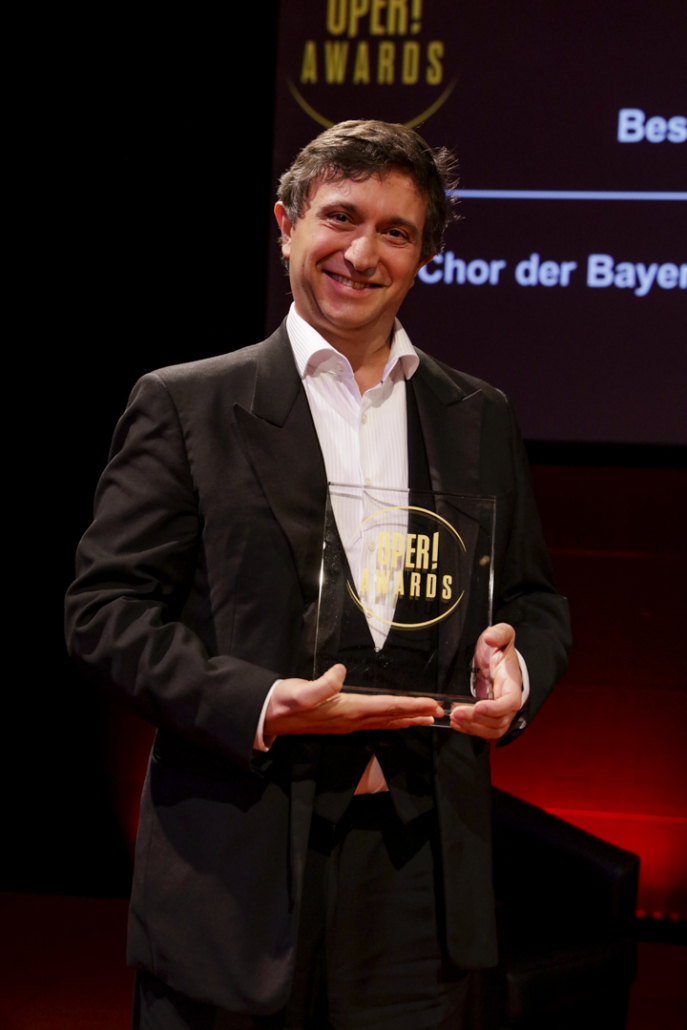
Best Choir

Bester Chor / Best Choir – Alberto Malazzi, Coro del Teatro alla Scala © Sylvain Guillot

Bester Chor / Best Choir – Alberto Malazzi, Coro del Teatro alla Scala © Sylvain Guillot

For obvious reasons, a choir needs to be as good as the opera house that employs it. But when — beyond being cheered as monks and camp followers in a common repertoire work as long and convoluted as Giuseppe Verdi’s La forza del destino — it also shines masterfully in a complex world premiere like Francesco Filidei’s Il nome della rosa, once again in habit; and when it further demonstrates vocal command over an entire evening of lesser-known Verdi operas, as it did under Riccardo Chailly’s baton at the Lucerne Festival, then the OPER! AWARDS “Choir of the Year” prize simply has to go to: the Coro del Teatro alla Scala under its director, Alberto Malazzi.

OPER! AWARDS 2025 - Raphaël Pichon © Marin Driguez

OPER! AWARDS 2025 – Dirigent Raphaël Pichon © Marin Driguez

Any conductor aiming to create new sound worlds is well-advised to set up their own orchestra and choir, allowing them the freedom to bring to life new art as well as old. That makes the ancient Greek artist, who fell in love with his own work, an excellent choice as patron saint and namesake. Since 2006, Raphaël Pichon and his ensembles have enriched the historically informed performance of baroque, classical and romantic works and created new pieces through reconstruction, collage or combination. A very special kind of musical experience was the 2024 premiere of the opera event Samson in Aix-en-Provence with music by Rameau, to whom our orchestra and choir of the year are closely linked by their name: Pygmalion.

© Michel Schnater. BESTER CHOR - The Monteverdi Choir

© Michel Schnater. BESTER CHOR – The Monteverdi Choir

At festivals, on concert tours and in their numerous recordings, this is an ensemble whose quality will always leave the listener speechless. The singers have long since gone beyond the realm of their namesake and opera co-inventor, having moved well into the 19th century. Whether Baroque, the Classical period or the Romantic era, their singing is always unerringly tailored to the specific stylistic requirements. Again and again they have proven that, in addition to religious introspection, they are also masters of the grand operatic gesture, astounding us in Berlioz’ Les Troyens.

OPER! AWARDS 2023, Juror Björn Woll mit Preisträger des Slowakischen Philharmonischen Chors

OPER! AWARDS 2023, Juror Björn Woll mit Preisträger des Slowakischen Philharmonischen Chors

Tchaikovsky’s Queen of Spades, gloriously performed by Kirill Petrenko last year in Baden-Baden and Berlin with his Philharmonic, made it clear yet again: this very Russian piece of universal musical heritage — which most certainly does not deserve to be banned — is one of the great choral operas, especially for male voices. The wonderful, sonorous and well-balanced Slovak Philharmonic Choir from Bratislava, founded in 1946 as broadcasting choir, since 1957 part of the Slovak Philharmonic, has demonstrated once more that it is one of the leading opera and concert choirs of the European music scene, cherished by many of the top conductors. Often engaged as an extra choir, on this occasion it shone, praiseworthy, all on its own.

An opera house in provisional quarters requires flexibility and creativity from all its staff members. In Cologne, during this extraordinary season, it was in particular the opera choir that excelled with high musical standards despite the changeable spatial and acoustic conditions of its temporary venue, the Staatenhaus. To shine even off-stage in Verdi’s Trovatore is just as outstanding as is having to move continually across the stage in small groups in Brett Dean’s Hamlet. The choir of Cologne Opera has demonstrated versatility and a strong presence.

Über Vielseitigkeit verfügt auch das andere künstlerische Kollektiv der Bayerischen Staatsoper: Ob Krenek oder Verdi, Wagner oder Donizetti, nichts scheint diesem Chor zu schwer, nichts auch unter seiner Würde. Denn Chorsänger, die sich in den philosophieträchtigen deutschen Musikdramen zu Hause fühlen, könnten schnell einen Bellini oder Rossini auf die leichte Schulter nehmen. Nicht so beim Chor der Bayerischen Staatsoper: Hier wird alles mit derselben künstlerischen Ernsthaftigkeit vorgetragen – und mit einem charakteristischen, herausragenden Chorklang.

Best World Premiere

Beste Uraufführung / Best World Premiere – Francesco Filidei und Hanna Dübgen © Sylvain Guillot

Beste Uraufführung / Best World Premiere – Francesco Filidei und Hanna Dübgen © Sylvain Guillot

Presenting a new opera based on a globally bestselling novel that has also been turned into a hugely successful film is a bold move, even when the Italian composer commissioned with the task can boast multiple awards. La Scala in Milan took the risk and was rewarded with an opulent three-hour work that, through the congenial collaboration of the directing team, cast and composer, evolved into a thrilling operatic experience: creepy and sensuous, witty and romantic, combining historical and contemporary elements in a first-class interpretation by the resident choir and orchestra under the musical direction of Ingo Metzmacher, alongside a perfectly cast ensemble of soloists. Damiano Michieletto’s production of Francesco Filidei’s musico-architectural masterpiece is our “Best World Premiere”: Il nome della rosa at the Teatro alla Scala.

Beste Uraufführung / Best World Premiere: „Die Jüdin von Toledo“, hier Librettist Hans-Ulrich Treichel. © Simon Van Rompay

Beste Uraufführung / Best World Premiere: „Die Jüdin von Toledo“, hier Librettist Hans-Ulrich Treichel. © Simon Van Rompay

An opera with arias, ensemble numbers and large choir scenes — it is rare to get something so traditional these days. The plot about a persecuted minority has as much historical as political relevance. The orchestration, shimmering between big emotions and reasons of state, was masterfully implemented by the Sächsische Staatskapelle under conductor Jonathan Darlington. Robert Carsen staged the work, commissioned by the Semperoper Dresden, both cleverly and effectively, Heidi Stober shone as the desperate title heroine, Christoph Pohl was the weak king responsible for her downfall. A stroke of good opera luck: Detlev Glanert’s The Jewess of Toledo.

© Milan Gino. Jan Henric Bogen, Operndirektor des Theaters St. Gallen, mit dem Team von Lili Elbe, BESTE URAUFFÜHRUNG

One might call it an old hat: transgender individuals on stage have been around nearly as long as opera itself. But never before has this topical socio-political subject been set to music in such a large-scale, skilfully touching way as in Lili Elbe by Tobias Picker — the production with which Theater St. Gallen courageously reopened its renovated house. In her portrayal of one of the first people to undergo gender reassignment, the female baritone Lucia Lucas in particular created a musical monument to this historical figure that also reflects the experiences of her own life.

Eurydice lives, Orpheus is dead at her feet. Did we get the myth wrong all that time? The composer Manfred Trojahn thinks so in his retelling of the ancient material at the Opera Amsterdam. Is it just a role she is playing, or does Eurydice show her true self? The stream of consciousness stutters and stumbles like a train moving over worn-out tracks. And a train conductor does indeed feature in the “narrative” that, mindful of musical traditions, recalls Wagner’s Tristan und Isolde. With little by way of outward action, but probing psychological depths the piece is in good hands with director Pierre Audi and conductor Erik Nielsen. A train journey into the past that offers hope for the future of opera.

In Brussels, Pascal Dusapin presented us with a surprise: his Shakespeare adaptation Macbeth Underworld at the Théâtre de la Monnaie. It was a short, intense night that director Thomas Jolly doused in darkness, set in a thicket of branches peppered with harsh white disco lights. It had chic, and a dash of musical irony by Jolly as much as Dusapin added zest to these Fearless Vampire Killers in the Scottish Highlands. Mr. and Mrs. Macbeth — the two wonderful, full-blooded tragico-comedians Georg Nigl and Magdalena Kožená — shambled through the scene like murderous phantoms, as funnily grotesque as they were tragically burlesque. Just like Dusapin’s seemingly eclectic score, tenderly painted by Alain Altinoglu’s baton.

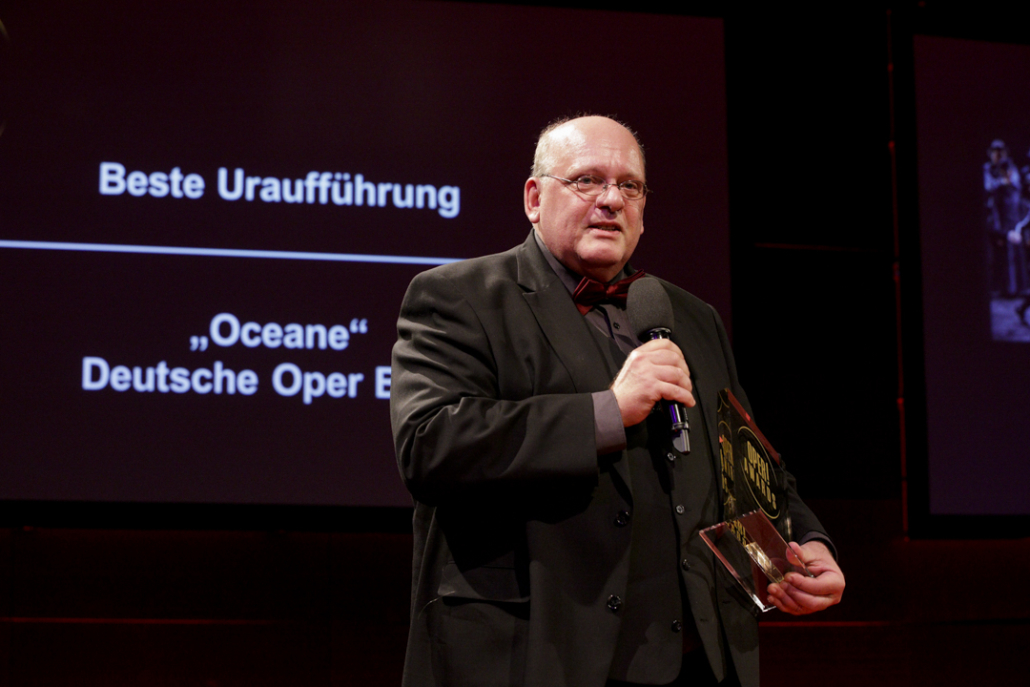
Mit seiner Oper Oceane ist Detlev Glanert ein echter Coup gelungen. Im Mittelpunkt steht eine geheimnisvolle Frau, die eine konservative Männergesellschaft in ihren Bann zieht und schließlich untergeht. Nicht nur beherrscht Detlev Glanert alle Finessen des Opernorchesters, er lässt der Musik und den Figuren auch ihr Geheimnis und ihre Rätselhaftigkeit. Ein faszinierendes Werk, das nach seiner erfolgreichen Uraufführung an der Deutschen Oper Berlin allen Intendanten zum Nachspielen ans Herz gelegt sei.

Best Performance

Beste Aufführung / Best Performance – Cecilia Bartoli © Sylvain Guillot

Beste Aufführung / Best Performance – Cecilia Bartoli © Sylvain Guillot

How to expand the repertoire without driving composers to burnout? The Baroque era had a clever answer to this question: pasticcios — the reassembling of existing arias, duets and choruses with a few libretto adjustments into a new opera. It is a trick that still works today. And it is especially effective when you have strong material from the compositions of Antonio Vivaldi at hand, as well as an excellent directing team, outstanding singers and musicians, then use this concentrated artistic power to tell a story connecting central cultural myths with the present day. The OPER! AWARD for “Best Performance” goes to Hotel Metamorphosis at the Salzburg Whitsun Festival.

Beste Produktion / Best Production: „Der Idiot“ bei den Salzburger Festspielen. Auf dem Foto: Intendant Markus Hinterhäuser. © Simon Van Rompay

Beste Produktion / Best Production: „Der Idiot“ bei den Salzburger Festspielen. Auf dem Foto: Intendant Markus Hinterhäuser. © Simon Van Rompay

A political piece, the final of seven operas by a composer who, along with his oeuvre, came close to being forgotten in the maelstrom of 20th-century catastrophes. The opera deals with the powerlessness of good people in a society marked by greed, nihilism and decadence. Krzysztof Warlikowski staged this parable in a shockingly dense manner on a horizontally movable space, perfect for arranging parallel scenes of simultaneous events. The actions of the top-rate cast were breathtakingly true to life, conductor Mirga Gražinytė-Tyla’s identification with the score compellingly poetic. Yes, this is exactly what festivals should be doing — recovering lost masterpieces for the repertoire: like Mieczysław Weinberg’s The Idiot at the Salzburg Festival.

Beste Aufführung / Best Production: The Greek Passion bei den Salzburger Festspielen / The Greek Passion at the Salzburg Festival

Beste Aufführung / Best Production: The Greek Passion bei den Salzburger Festspielen / The Greek Passion at the Salzburg Festival

The issues that moved the composer Bohuslav Martinů 70 years ago to turn Nikos Kazantzakis’ novel into an opera still affect us today: refugees, a divided society, the tragic escalation into violence. When the dramatic and musical realisation of a work this relevant succeeds on such a high level, both the programme planners and the creative minds have got everything right. The Greek Passion at the Salzburg Festival 2023, thrillingly conducted by Maxime Pascal and grippingly directed by Simon Stone, was for us the best performance of the year.

OPER! AWARDS 2023, Jurorin Franziska Stürz mit Christopher Warmuth, Dramaturg der Bayerischen Staatsoper

This dark contemporary piece about politics, faith, delusion and madness stood like an exclamation mark over the Munich Opera Festival 2022. Director Simon Stone and stage designer Bob Cousins incisively steered our gaze to the timeless content of the story, music director Vladimir Jurowski and the Bavarian State Orchestra turned the pitiless score into an auditory experience. Heading a thoroughly convincing cast of soloists, Aušrinė Stundytė blazed as Jeanne.

Jean-Philippe Rameau’s baroque revue Les Indes galantes at the Bastille Opera was transformed into a ravishing festival of life by the artist and film director Clément Cogitore. He offered stylised vignettes from a 21st-century multicultural metropolis — like Paris — while the splendid choreographer Bintou Dembélé cranked up the moves of her dancers, rappers and hip-hoppers. Baroque and banlieue, blending in an irresistible mix. A big part in this contemporary dance show of gavottes and menuets was also played by conductor Leonardo García Alarcón and his Cappella Mediterranea. Oh, and did we mention it? There was some very fine singing, too!

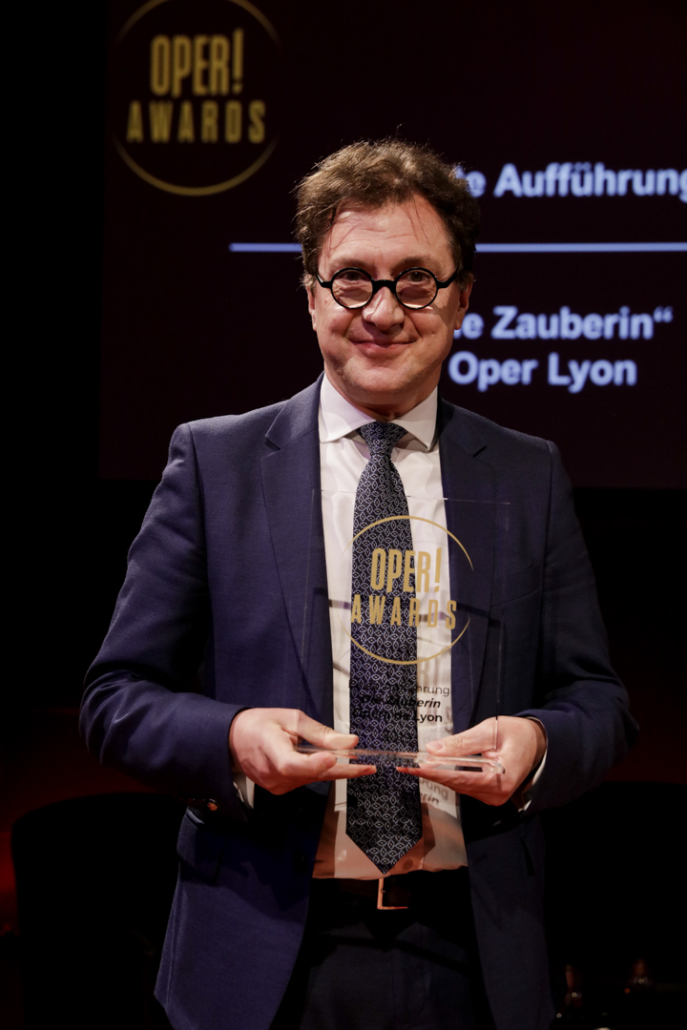
Regisseur Andriy Zholdak begeisterte mit Tschaikowskys viel zu selten gespielter Zauberin. Nicht selten überspannt er dabei den Regieeinfallbogen, aber Zholdak fasziniert mit seinen bisweilen surreal jedem linearen Erzählen spottenden Einfällen und seiner vielschichtigen Personenregie. Zudem war dies eine Produktion mit einem idealen Sängerteam und dem richtigen Dirigenten (Daniele Rustioni), die der Opéra de Lyon unter ihrem Intendanten Serge Dorny wieder einmal zu Ehren gereicht. Eine rundum überzeugende Aufführung!

Best Stage Designer

Bester Bühnenbildner / Best Stage Designer – Jo Schramm © Sylvain Guillot

Bester Bühnenbildner / Best Stage Designer – Jo Schramm © Sylvain Guillot

There are still a number of theatre creatives around who once revolved in the “Schlingensief orbit” during their younger years. One of them had previously studied architecture — a fact still visible in his work today, in his masterful play with kinetic elements. This artist is capable of building moving spaces that begin to “speak”. For Schlingensief, he invented the stage for Rosebud and Hamlet. For David Hermann, he created the legendary ramp for the world premiere of Gordon Kampe’s opera Dogville. Just as menacingly silent were the shifting concrete walls of the recent Don Giovanni in Munich, followed by his second bullseye of the season: the plenary hall for Albéric Magnard’s opera Guercœur in Frankfurt, which showed democracy literally collapsing in on itself. Just one of the masterpieces of our “Stage Designer of the Year”: Jo Schramm.

Bester Bühnen- und Kostümbildner / Best Stage and Costume Designer: Christophe Coppens. © Simon Van Rompay

Bester Bühnen- und Kostümbildner / Best Stage and Costume Designer: Christophe Coppens. © Simon Van Rompay

At the Théâtre de la Monnaie / De Munt, he has staged and designed The Cunning Little Vixen in 2017, a Bartók double feature in 2018, Norma in 2021 and Turandot in 2024 — all in his very own, atmospherically dense and colourfully sophisticated way and, team player that he is, without omitting the support of the i.s.m.architecten studio for the set designs. His stage work always bears witness to a universal interest in art, fashion and design. His opera stagings are always closely interlinked total works of art, with a very special visual touch. The set and costume designer for 2025 is Christophe Coppens.

© Michel Schnater. Uwe Friedrich, Mitglied der Jury, und Paul Zoller - BESTER BÜHNENBILDNER

© Michel Schnater. Uwe Friedrich, Mitglied der Jury, und Paul Zoller – BESTER BÜHNENBILDNER

Dante is wasting his life in a mysterious labyrinth at the Staatstheater Braunschweig. At the end of a hallway or flight of stairs, the door opens into a room unexpected by him or the audience. A challenge for the workshops and stage technicians, a triumph with audiences and critics — just as Die Frau ohne Schatten at the Festspielhaus Baden-Baden. The interiors, exteriors and desert spaces for Massenet’s Hérodiade in Düsseldorf, too, retained their mystery and at the same time opened up spaces of mental associations, while older designs by Paul Zoller, such as for Turandot in Berlin, demonstrate excellent repertoire qualities.

OPER! AWARDS 2023, Juror Manuel Brug mit Preisträger Ulrich Rasche

OPER! AWARDS 2023, Juror Manuel Brug mit Preisträger Ulrich Rasche

Ulrich Rasche is much in demand throughout German-speaking areas with his choric designs inspired by Greek antiquity. In 2022, he made his opera debut with Strauss’ Elektra in Geneva. The premiere turned into a triumph for the musical score, the concept and the cast. Rasche remained true to himself: his minimalist trademark is the permanent movement of actors, to have them walking or running through dark, smoke-screened spaces, lit by beams of light, over animated barrels, rollers and conveyor belts. In Geneva, they all marched across the same rotating, inclined surface that could be tilted and pulled up, looking for all intents and purposes like the stage-set for a heavy metal gig. But then, why not? Richard Strauss is, after all, opera’s hard rock composer.

To make one’s directorial debut with a piece as difficult as Franz Schreker’s The Smith of Ghent (Der Schmied von Gent) suggests either total fearlessness, incredible naivety or towering self-confidence. Or possibly all of the above. However, the result was a breath-taking succession of images within the sets designed by Mondtag himself, which borrowed from picturesque, art historical Flanders clichés, but also presented the horrors of colonialism in a wild riot on the stage of the Opera Ballet Vlaanderen, in the process rescuing the opera from the misconception of being a minor late work of the composer.

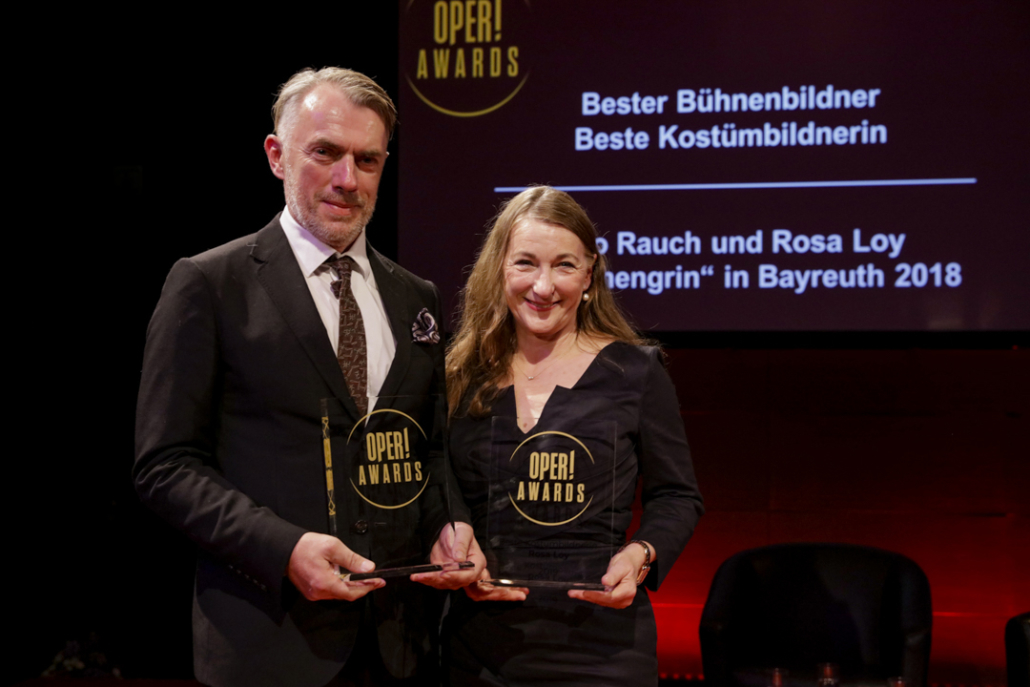
Der Bayreuther Lohengrin im Sommer 2018 offerierte keine reine Schönheit, sondern eine gestörte Poesie, eine, die verstört. Der Maler Neo Rauch zeigte hinter dem barockbühnenhaft aufgerissenen Proszenium neuerlich und nachdrücklich, auch ein bisschen neurotisch, die zeitgemäße Schönheit einer neoromantischen Schwanenritterfabel aus dem Geist des frühmodernen Wimmelbilds: Als Lust am Sehen, am Staunen über alte Theatertricks. Die ewige Faszination der Illusion, die sich großzügig, intelligent und augenzwinkernd ausstellt und bisweilen auch rätselhaft bleibt.

Best Costume Designer

Beste Kostümbildnerin / Best Costume Designer – Cécile Trémolières © Sylvain Guillot

Beste Kostümbildnerin / Best Costume Designer – Cécile Trémolières © Sylvain Guillot

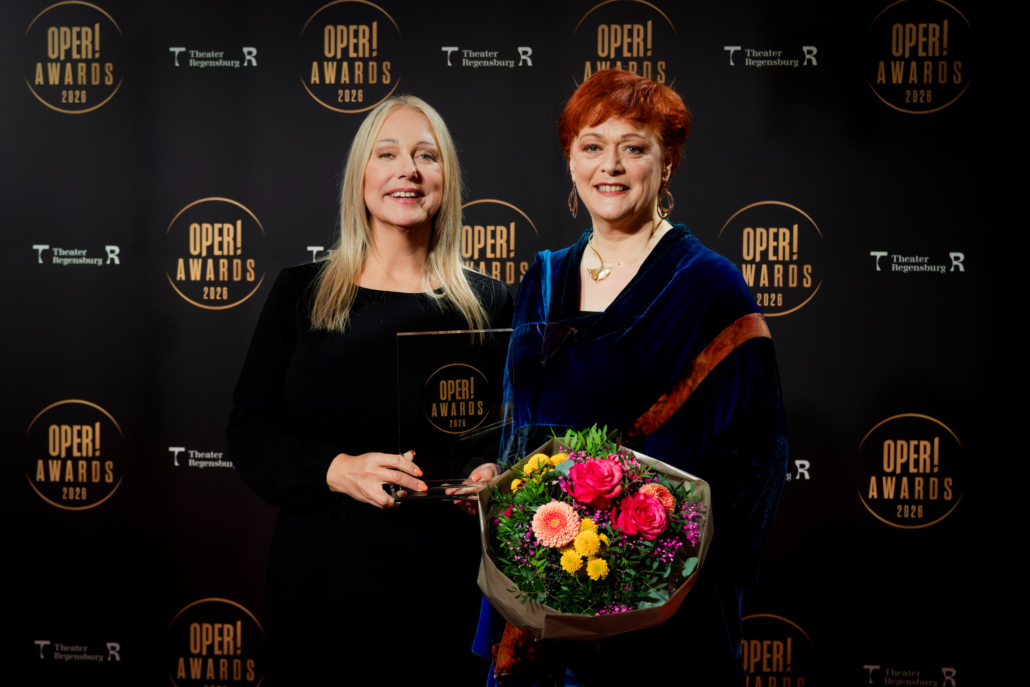
There are opera reviews in which the costume designers are not even mentioned. Yet to overlook the work of this year’s award winner is quite simply impossible. Her designs for the Magdeburg Tannhäuser, full of late-medieval forms and colours, look like the cast of the fairy-tale film Three Hazelnuts for Cinderella who have accidentally wandered onto Wartburg, the pilgrims’ chorus like an echo of Monty Python’s Life of Brian. These thoroughly satirical exaggerations reveal themselves as precise character studies full of precious, cleverly conceived details. The OPER! AWARD for “Best Costume Designer” 2026 goes to: Cécile Trémolières.

Bester Bühnen- und Kostümbildner / Best Stage and Costume Designer: Christophe Coppens. © Simon Van Rompay

Bester Bühnen- und Kostümbildner / Best Stage and Costume Designer: Christophe Coppens. © Simon Van Rompay

At the Théâtre de la Monnaie / De Munt, he has staged and designed The Cunning Little Vixen in 2017, a Bartók double feature in 2018, Norma in 2021 and Turandot in 2024 — all in his very own, atmospherically dense and colourfully sophisticated way and, team player that he is, without omitting the support of the i.s.m.architecten studio for the set designs. His stage work always bears witness to a universal interest in art, fashion and design. His opera stagings are always closely interlinked total works of art, with a very special visual touch. The set and costume designer for 2025 is Christophe Coppens.

© Michel Schnater. Klaus Bruns - BESTER BÜHNENBILDNER - und Eleonore Buening, Mitglied der Jury

© Michel Schnater. Klaus Bruns – BESTER BÜHNENBILDNER – und Eleonore Buening, Mitglied der Jury

Every animal fable carries with it a hefty dose of morality. Klaus Bruns ignored this tradition of finger pointing and finger wagging that stretches from Aesop to Disney. His semi-transparent masks for Animal Farm at the Dutch National Opera Amsterdam are neither cute nor easy to read. They are ambivalent: sad and evil, vulnerable and threatening. An imagery that is almost essential to the uncomfortable truths of this opera: a masterpiece. For many years, Bruns has been designing tailor-made costumes for plays and operas in a variety of individual ways, in close collaboration with major directors. This award is not his first. But well deserved.

OPER! AWARDS 2023, Juror Manuel Brug mit Preisträger Ersan Mondtag und Annika Lu

OPER! AWARDS 2023, Juror Manuel Brug mit Preisträger Ersan Mondtag und Annika Lu

A colourful potpourri: that is the recipe for many, though not all of Ersan Mondtag’s works. He is always best as his own stage and costume designer, sometimes assisted by a co-creative. In the case of the raw, essentially unplayable Antikrist by Rued Langgaard that person was Annika Lu. At the Deutsche Oper Berlin this anticlerical musical pamphlet between apocalypse and rebirth unfolded into a triumph of imagination, a gaudy invocation of the expressive 1920s. Baffling but mesmerizing: God as a monstrous naked puppet and the Great Whore of Babylon in a massive, hatching-patterned fat suit.

The technicolour imagery of director Ersan Mondtag for Schreker’s The Smith of Ghent (Der Schmied von Gent) would have worked only half as well without Josa Marx’s inventive costumes. Here, too, we find a childlike enjoyment of shapes and colours mixing with the fearsome elements of Dutch painting from Hieronymus Bosch to Pieter Bruegel. Josa Marx combined these suggestive references, from the past right up to the present, to create an unmistakable signature that enlivened Mondtag’s strikingly nested revolving stage in a congenial manner.

Rosa Loy ist keine reine Kostümbildnerin, sondern Neo Rauchs Frau und Partnerin auf Augenhöhe. Vormärz und Frühmoderne mischen sich in ihren Arbeiten, genauso wie Rembrandt-Kragen, Babystrampler, Trainingsanzug, Krankenschwesteruniform und Hausdamenkostüm: van Dyck und Schilda sind sich nah. Dann kommt Piotr Beczała als Tenor-Heilsbringer im Mechanikeranzug und versucht zu reparieren. Und in Bayreuth zieht mit Lohengrin wieder das Schöne ein.

Best Solo Album

Bestes Solo-Album / Best Solo Album – Erin Morley © Sylvain Guillot

Bestes Solo-Album / Best Solo Album – Erin Morley © Sylvain Guillot

The golden age always seems to lie a few decades in the past. Older generations still remember it, younger ones yearn for it. But sometimes, it exists in the present. In those moments, we hear voices that manage to measure up to the all-time greats of the past — voices that can thrill us and make us forget time itself, as well as the centuries that lie between us and the creation of the compositions. Whether that is Italian bel canto or French melodiousness turns out to be as secondary as the plot of the opera in question, because the beauty of the music overwhelms us directly, needing no intermediary. When two performers, highly in demand from New York to Tokyo, come together and complement each other perfectly in their stylistic confidence and vocal technical perfection, the audience finds itself transported to operatic heaven — as is the case with our “Album of the Year”: Golden Age by Erin Morley and Lawrence Brownlee.

Bestes Solo-Album / Best Solo Album: Aigul Akhmetshina. © Simon Van Rompay

Bestes Solo-Album / Best Solo Album: Aigul Akhmetshina. © Simon Van Rompay

Two hours of singing lessons per week are the norm for students at German music academies. That is strikingly little. The singer, who made the best impression in terms of her recordings this year, says she studied “six hours a day” at her academy — in Ufa, capital of the Republic of Bashkortostan in southern Russia. The result: a glittering super mezzo with an iridescent vibrato. On her debut album under the direction of Daniele Rustioni, she sings arias of almost all the magnificent roles in her field: Carmen, Rosina, Cenerentola and Charlotte, as well as Romeo in Bellini’s Shakespeare-inspired I Capuleti e i Montecchi. With this recording — titled “Aigul” — she has managed to create the best solo album of the year: Aigul Akhmetshina.

Bestes Solo-Album / Best Solo Album: Cyrill Dubois

Bestes Solo-Album / Best Solo Album: Cyrill Dubois

The French tenor Cyrille Dubois has been an integral voice of the recordings of Palazzetto Bru Zane for many years. Yet as a soloist, it is only with his album So Romantique! that he has become truly unmistakable. Unknown arias from Godard’s Pedro de Zalamea, Halévy’s Les mousquetaires de la reine or Clapisson’s Gibby la cornemuse are ideal for his nasally elegant, sensitively melting timbre. In Donizetti’s La fille du régiment Dubois does not need to hide from the Italian knights of the High C. The Orchestre National de Lille, too, will be moving into the top league with this recording.

OPER! AWARDS 2023, Preisträger Jonathan Tetelman

OPER! AWARDS 2023, Preisträger Jonathan Tetelman

Giacomo Puccini is his favourite composer, but luckily Jonathan Tetelman resisted the temptation to include the popular, but well-worn tenor hits of this occasionally somewhat sentimental master of opera. Instead, he offers a mix of French lyricism, Italian trumpet sounds and the sheer joy of musical ingenuity. His voice is versatile and seems to know no technical limits. In the bigger scenes, Tetelman shows himself to be in full control when switching between tension and serene sonority. He avoids being overbearing in the duets with his vocal partner, Vida Miknevičutė, and the interactions with conductor Karel Mark Chichon similarly show him to be a team player.

What a voice! With his solo album Vincerò!, Piotr Beczała — Best Singer of last year’s OPER! AWARDS — again stakes a claim to the throne of tenors. Exciting in his high registers that have become ever more free and assured in recent years, with a beautiful, glistening tear in the right moments. He shines with exemplary technique and well-tempered expression rather than high-pressure emotions in this verismo repertoire. Vincerò! is another successful step towards more dramatic parts in Beczała’s intelligently managed career.

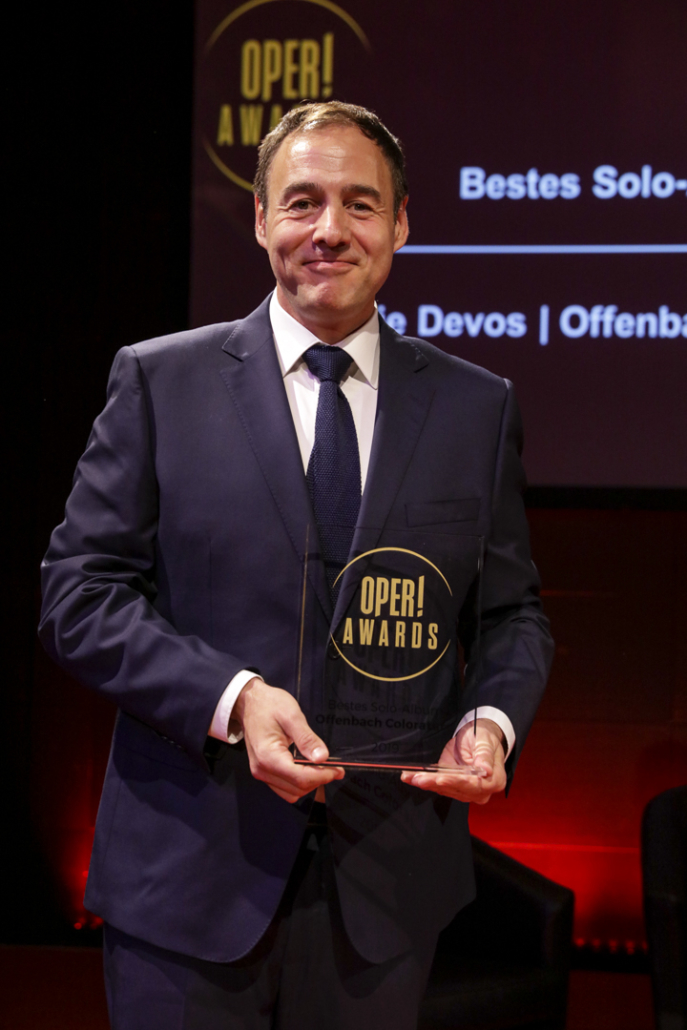
Mit „Offenbach Colorature“ ist Jodie Devos nicht nur ein kluges Album gelungen, das uns viele vergessene Arien-Juwelen von Jacques Offenbach erleben lässt. Die sind darüber hinaus auch noch fantastisch und mitreißend musiziert. Mit Augenzwinkern, Wortwitz und feiner Koloraturentechnik serviert die Sängerin hier einen wahren Ohrenschmaus. Was auch an der feinfühligen und idiomatischen Unterstützung durch den Dirigenten Laurent Campellone und dem Münchner Rundfunkorchester liegt.

Best Complete Edition

Beste Gesamtedition / Best Complete Edition - Donizetti Songs (Opera Rara), Henry Little © Sylvain Guillot

Beste Gesamtedition / Best Complete Edition – Donizetti Songs (Opera Rara), Henry Little © Sylvain Guillot

Just when you think you know the style of a composer responsible for some of the greatest masterpieces of Italian bel canto, know the melodies that time and again grace the request concerts, know his formal mastery that remains admirable to this day and his harmonic surprises that would have sufficed for several careers… Along comes the delightful realisation: the man also wrote songs — and what songs they are! The singers involved pour out a cornucopia of ideas and vocal challenges, constantly amazing us with the elegance and perfection of their artistry. Not everything has even been released yet, but we are already looking forward to the subsequent albums of the now well-advanced collection of Gaetano Donizetti’s songs produced by the label Opera Rara, our “Best Complete Edition”, bearing the simple title: Donizetti Songs.

Beste Opern-Gesamtaufnahme / Best Opera Recording: Le prophète (London Symphony Orchestra) - here Becky Lees. © Simon Van Rompay

Beste Opern-Gesamtaufnahme / Best Opera Recording: Le prophète (London Symphony Orchestra) – here Becky Lees. © Simon Van Rompay

The French grand opéra is the most successful invention of the opera composers of the 19th century, yet there have been hardly any convincing full-length recordings of these works. This has been changing in recent years thanks to the editorial work of the Palazzetto Bru Zane with its outstanding CD series. Religious zealots, erotic entanglements, a grand ballet: all of this is in the best possible hands with conductor Mark Elder, who, together with the London Symphony Orchestra, makes the score shimmer in all the colours. John Osborn sings the charismatic leader with great seductive power, Elizabeth DeShong is an overwhelming Fidès. Played in such a brilliant fashion, this special work will defend its place in opera history: Meyerbeer’s Le prophète.

Beste Opern-Gesamtaufnahme / Best Opera Recording: La princesse de Trébizonde (Opera Rara)

Beste Opern-Gesamtaufnahme / Best Opera Recording: La princesse de Trébizonde (Opera Rara)

While the golden age of opera recordings may be over as the big labels have pulled out, Opera Rara continues to release many of today’s most important opera and operetta titles. In Jacques Offenbach’s La princesse de Trébizonde, ex-ENO conductor Paul Daniel and the London Philharmonic Orchestra discover their humorous side. With Virginie Verrez as Prince Raphael, Anne-Catherine Gillet and Antoinette Dennefeld, strict attention is paid to idiomatic expression. The Canadian tenor Josh Lovell is a discovery in a class of his own. All in all, a great moment of the “Offenbachiade”.

OPER! AWARDS 2023, Juror Björn Woll mit Preisträgerin Antonella Zedda von Palazzetto Bru Zane

OPER! AWARDS 2023, Juror Björn Woll mit Preisträgerin Antonella Zedda von Palazzetto Bru Zane

For quite a few years now the Palazzetto Bru Zane foundation has been successfully diving for mostly pearls of French romanticism, releasing them in an exemplary fashion with acknowledged experts of that repertoire. Robert le Diable adds one of Giacomo Meyerbeer’s central pieces to their programme, recorded in co-operation with the Opéra National de Bordeaux to the accustomed high standards. Meyerbeer expert Marc Minkowski conducts an illustrious cast of singers, led by John Osborn, Erin Morley and the diabolic Nicolas Courjal. Yet another convincing contribution to the Meyerbeer renaissance.

A highlight of the Berlioz year 2019: John Eliot Gardiner’s Benvenuto Cellini, a live concert recording on DVD from the Opéra de Versailles. His conducting is cheerful, the Orchestre Revolutionnaire et Romantique whispers and blares with a rich timbre, the Monteverdi Choir is nimble and witty. All are full of fervour and perfectly cast, making it pure joy to listen to this, Berlioz’ most colourful, frivolous and multifaceted opera, set among the artists of Renaissance Rome. The vocal cherry on top: Michael Spyres sings Benvenuto with poise and charm and a well-rounded baritonal tenor voice. This recording is an opera must-have!

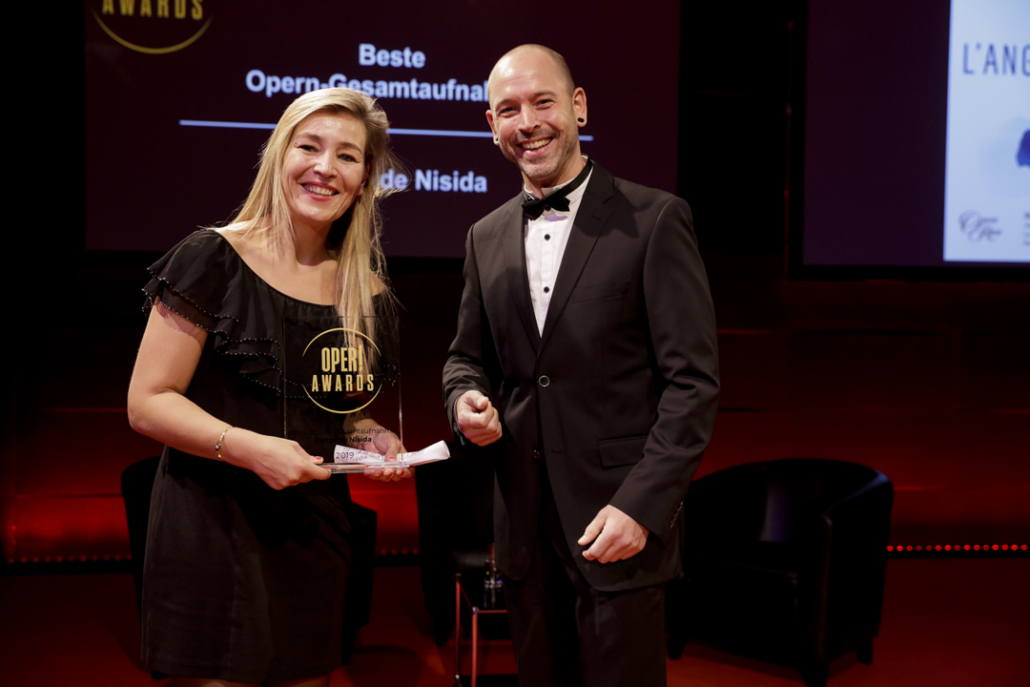
Ausgrabungen gibt es regelmäßig, doch selbst in der Barockmusik sind wirklich lohnende Werke und bahnbrechende Entdeckungen selten geworden. Umso erstaunlicher daher, was dem Label Opera Rara mit L’ange de Nisida gelungen ist: Nicht weniger als ein Hauptwerk von Gaetano Donizetti wurde hier ans Licht befördert und in einem enthusiastischen Live-Mitschnitt zum klingenden Leben erweckt.

Best Newcomer

Beste Nachwuchskünstlerin / Best Newcomer – Nadezhda Karyazina © Sylvain Guillot

Beste Nachwuchskünstlerin / Best Newcomer – Nadezhda Karyazina © Sylvain Guillot

It is, of course, a wonderful thing being able to shine, at a young age, in a major role at a significant festival. But to go beyond that, to radiate authority and vocal brilliance in the iconic part of Marfa in Mussorgsky’s Khovanshchina — a sort of death-obsessed Russian Erda usually reserved for older singers —, to garner rave reviews and applause at an event like the Salzburg Easter Festival: that is truly a special achievement! Just a few weeks later, she repeated that feat as a substitute — chosen quite likely due to the earlier success —, “checking in” as Minerva, Nutrice and Juno at the Hotel Metamorphosis in the same city for the Whitsun Festival. She is, quite simply, overwhelmingly good: our “Newcomer of the Year”, Nadezhda Karyazina.

Bester Nachwuchskünstler / Best Newcomer: Maayan Licht. © Simon Van Rompay

Bester Nachwuchskünstler / Best Newcomer: Maayan Licht. © Simon Van Rompay

Back when Alfred Deller caused amazement with his falsetto acrobatics, no one expected that a new Stimmfach would one day emerge from this. Now the time has come: countertenors had an unprecedented run in 2024, and entire baroque operas can now be cast with haute-contres in all the major roles. At the Bayreuth Baroque Festival, a young soprano stole the show, eclipsing even stars of the scene. He gave Achilles in Porpora’s Ifigenia in Aulide the most heartfelt intensity and beguiling acrobatics. A true whiz kid: after completing his studies in Amsterdam, he enjoyed instant success in Vienna, Brno, Parma, Oldenburg and Glyndebourne, among other places. More than 80,000 fans already follow him on Instagram and TikTok. His name: Maayan Licht.

Bester Nachwuchskünstler / Best Newcomer: Huw Montague Rendall

Bester Nachwuchskünstler / Best Newcomer: Huw Montague Rendall

As a searching, stumbling Hamlet at the Komische Oper Berlin, the British baritone Huw Montague Rendall made tickets sell like hot cakes. It was the same in London, Paris, Chicago, Aix and Glyndebourne. His Pelléas was just as acclaimed as his Papageno, Eisenstein and Malatesta. It all began with Fiorello at the Glyndebourne Festival, a small part with big consequences. Whether Count Almaviva in Figaro, Kindertotenlieder or Duruflé Requiem, Rendall fits it all in and hits the right notes.

Preisträger Konstantin Krimmel (links) mit Pianist

Preisträger Konstantin Krimmel (links) mit Pianist

Amazing — here is a passionate Lied and concert singer, a hobby tenor who caught the theatre virus as a member of the choir in his home town of Ulm, then making it into the ensemble of the Bavarian State Opera before he was even 30. As a baritone! Konstantin Krimmel has so much fun with music and the telling of stories, he simply had to end up on stage. Here, he can charm us, he can revel or grumble or make merry like Papageno. His voice and musicality have won over critics and, even more so, audiences. Whether on award-winning recordings or in the opera house: Konstantin Krimmel is one of the most versatile and promising young German baritones on international stages.

The Brazilian Bruno de Sá might become the first male soprano to achieve a global career. He made a splash as little Mermaid in the Basel world premiere of Andersens Erzählungen, but also as Barbarina in Le nozze di Figaro. His contribution to the CD release of Bononcini’s Polifemo also told us to sit up and take notice. A solo recording contract soon followed. De Sá’s voice is soft, keeping its warmth even in the highest registers while eschewing mere vocal fireworks. Instead, we hear an extremely accomplished, extremely respectable singer doing pioneering work.

Zuerst ist uns der heute 24-jährige baskische Tenor mit seiner klaren, schönen Stimme und der gut durchgebildeten Höhe in Pesaro und in Bergamo aufgefallen, wo er unter anderen mit Juan Diego Flórez auf der Bühne stand. Rossini und Donizetti liegen ihm perfekt in der Kehle. Dafür wurde er eben auch beim Operalia Wettbewerb in Prag gleich zweifach ausgezeichnet. Hier ist ein Sänger mit einer jugendfrischen Stimme zu erleben, die schon jetzt mehr als nur ein Versprechen für die Zukunft ist.

Best Rediscovery

Beste Wiederentdeckung / Best Rediscovery – Die toten Augen, Theater Altenburg Gera © Sylvain Guillot

Beste Wiederentdeckung / Best Rediscovery – Die toten Augen, Theater Altenburg Gera © Sylvain Guillot

There are opera titles that have become almost legendary, even if hardly anyone has ever seen the actual piece performed. Anyone reading an opera guide might assume that a story as crude as this one could never work on stage and that there are likely good reasons why it never appears in the repertoire. Then, just like that, someone comes along who believes in the work and trusts the music: a director unafraid of symbolism and pathos, who also happens to be the director of a house capable of casting even the most demanding roles of a Late Romantic opera. Thus, from the very first intoxicating notes, it was clear that this rediscovery of an opera by Eugen d’Albert was long overdue and absolutely worthy of an award: Die toten Augen (The Dead Eyes) at the Theater Altenburg Gera.

Beste Wiederentdeckung / Best Rediscovery: Amerika by Roman Haubenstock-Ramati am Opernhaus Zürich, hier Claus Spahn. © Simon Van Rompay

Beste Wiederentdeckung / Best Rediscovery: Amerika by Roman Haubenstock-Ramati am Opernhaus Zürich, hier Claus Spahn. © Simon Van Rompay

If an opera is rejected by the public, it does not necessarily say anything much about the work itself; it may just mean the time was not yet right for it. Re-examining a failure, however, requires courage, and that is exactly what the Zurich Opera and director Sebastian Baumgarten have shown. Under the baton of conductor Gabriel Feltz, the elaborate musical drama about Franz Kafka’s long-suffering hero Karl Rossmann turns into a captivating night at the opera during which acting, singing, dancing and stage tech merge into a total work of art that is intended to overwhelm but above all intended to make you think. And so, almost 60 years after its world premiere, a very special stage work became an acclaimed success: Roman Haubenstock-Ramati’s Amerika.

© Milan Gino. Jens Neundorff von Enzberg, Intendant des Staatstheaters Meiningen, BESTE WIEDERENTDECKUNG

© Milan Gino. Jens Neundorff von Enzberg, Intendant des Staatstheaters Meiningen, BESTE WIEDERENTDECKUNG

In an ironic twist, the German premiere of George Bizet’s Ivan the Terrible, or Ivan IV, at the courageous Staatstheater Meiningen took place on the first anniversary of the Russian invasion of Ukraine. While long in the making before these events, director Hinrich Horstkotte’s creative adaptation to its historical settings added further relevance. Thus, an exciting, tonally interesting piece, for which opera history previously had had little regard, took on new urgency. A few minutes of its music even had their world premiere that night — which just goes to show a sense of curiosity well and alive in what is often disparagingly regarded as the provinces.

OPER! AWARDS 2023, Jurorin Franziska Stürz mit Preisträger Andreas K. W. Meyer, Operndirektor Bonn

OPER! AWARDS 2023, Jurorin Franziska Stürz mit Preisträger Andreas K. W. Meyer, Operndirektor Bonn

Devoting an entire series of productions to the forgotten musical drama of the first third of the 20th century is bound to lead to some exciting new encounters: FOKUS ’33 is an exemplary musicological research project in co-operation with the Oper Bonn that returned pieces like Meyerbeer’s Ein Feldlager in Schlesien or Asrael by Alberto Franchetti to the stage. Flanked by informative events and talks, our current perspective vis-à-vis this repertoire is broadened, an evening at the opera becomes a sensuous experience with a sharpened historical consciousness. The reasons why these pieces fell into oblivion are as varied as they are themselves.

A dragon and a wild drama: Weimar and Erfurt, for the first time since 1971, resurrected Paul Dessau and Heiner Müller’s malicious polit-opera Lanzelot, in Peter Konwitschny’s striking and sleek direction. A dragon terrorises the land, each year it demands a virginal sacrifice. A knight, Lanzelot, turns up, but nobody really is much bothered, and the reigning nomenclature is quite ok with the state of things. This odd but piercing piece premiered in 1969 at the Berlin State Opera. As the GDR powers that were assumed the dragon to exemplify the capitalist West they applauded this “socialist revolutionary opera of human self-liberation”.

Dickes Ausrufezeichen im Offenbach-Jubiläumsjahr: An der Opéra national du Rhin Strasbourg verpassten Regisseurin Mariame Clément und Jean-Luc Vincent dessen Barkouf neue, an heutige politische und gesellschaftliche Problemzonen angepasste Dialoge. Und Mariame Clément stellte mit Bühnenbildnerin Julia Hansen auch den Kern des Stückes sicher: animalische Frauenpower gegen hirnlose Machtmänner. Mit der im Mai viel zu früh gestorbenen Intendantin Eva Kleinitz hatte eine kluge Theaterfrau darüber hinaus den Mut, diesen unbekannten Offenbach auf die Bühne zu stellen.

Best Future Project

Bestes Zukunftsprojekt / Best Future Project – Verdi OFF, Festival Verdi Parma © Sylvain Guillot

Bestes Zukunftsprojekt / Best Future Project – Verdi OFF, Festival Verdi Parma © Sylvain Guillot

Major festivals dedicated to a single composer usually have their hands full simply maintaining the legacy of their namesake, especially when the oeuvre is vast and many of the works are seldom performed. This makes it all the more important to facilitate fresh perspectives: the devastating effect of groundless jealousy in a condensed theatrical version of a famous opera; linking the downfall of a tyrant to the climate crisis in an art installation; an intimate encounter — in bed, no less — with a dying opera character. All of this can help to experience a work in real life, as it were, outside the context of the opera house, thrilling an audience that does not yet realise just how close the old art form can get to them. For ten years now, a very special educational initiative has been achieving all of this — for us, they are the “Best Future Project”: the Verdi OFF Festival in Parma.

Bestes Zukunftsprojekt / Best Future Project: Copenhagen Opera Festival. © Simon Van Rompay

Bestes Zukunftsprojekt / Best Future Project: Copenhagen Opera Festival. © Simon Van Rompay

How do you make opera fit for the future? For example, by picking relevant topics that artists then shape into exciting music theatre. New pieces often fail because of their form, whether full-length large-scale productions or small performances. But there is another way: when courage for new compositions, formats and narratives is coupled with proficiency. When political relevance is matched with convincing aesthetic solutions. The result will be the attraction of alert, young audiences that many other festivals and theatres can only dream of. Take a leaf out of the book of our best future project: the Copenhagen Opera Festival.

© Michel Schnater. Peter de Caluwe, Director La Monnaie De Munt - BESTES ZUKUNFTSPROJEKT - Green Opera

© Michel Schnater. Peter de Caluwe, Director La Monnaie De Munt – BESTES ZUKUNFTSPROJEKT – Green Opera

The opera house in Brussels has been consistently addressing the impact of its activities on the environment for 23 years. Reduction of CO2 emissions, sustainability and environmental awareness among all employees are its declared goals. La Monnaie / De Munt has been pursuing the “Green Opera” project as part of its CSR strategy since 2022. Waste separation, noticeably reduced energy and water consumption, beehives on the roof, self-made detergents and the recycling of stage designs, in addition to bicycle racks and optimised in-house logistics — these are just a few of the changes, which are also being promoted at Collectif 17h25. Exemplary!

Best Festival

Bestes Festival / Best Festival – Christoph Dittrich und Ludger Vollmer, Theater Chemnitz © Sylvain Guillot

Bestes Festival / Best Festival – Christoph Dittrich und Ludger Vollmer, Theater Chemnitz © Sylvain Guillot

Was tut man als Opernhaus, wenn man eine vielversprechende Uraufführung stemmen möchte, aber die Mittel begrenzt sind? Man setzt sich dafür ein, dass der eigene Standort Europäische Kulturhauptstadt wird. Mit dem dadurch fließenden Geld beauftragt man eine berühmte Autorin und einen erfahrenen Komponisten, ein Stück Weltliteratur zu vertonen, das in der Region spielt. Drumherum baut man ein prominent besetztes Symposium als Festival im Festival. Das Ergebnis: ein Riesenerfolg. Die Vorstellungen sind ausverkauft, wegen der großen Nachfrage gibt’s Zusatztermine. Der OPER! AWARD für das „Beste Festival“ geht 2026 an das Theater Chemnitz und das Kulturhauptstadtjahr, die die Opern-Uraufführung Rummelplatz von Jenny Erpenbeck und Ludger Vollmer nach dem Roman von Werner Bräunig ermöglicht haben.

What do you do as an opera house when you want to pull off a promising world premiere but funds are limited? Easy — you campaign for your city to become a European Capital of Culture! With the resulting funding, you commission a famous author and an experienced composer to set a piece of world literature to music that takes place in your region. Around this, you organise a high-profile symposium as a “festival within a festival”. The result: a massive success, with sell-out performances and more dates added due to popular demand. The OPER! AWARD for “Best Festival” 2026 goes to the Theater Chemnitz and the European Capital of Culture, which made possible the world premiere of Rummelplatz (Fairground) by Jenny Erpenbeck and Ludger Vollmer, based on the novel by Werner Bräunig.

Bestes Festival / Best Festival: Opernfestspiele Heidenheim, hier Markus Bosch. © Simon Van Rompay

Bestes Festival / Best Festival: Opernfestspiele Heidenheim, hier Markus Bosch. © Simon Van Rompay

The town has close to 50,000 inhabitants, a football team in the first German Football — and an opera festival in summer. Since conductor Marcus Bosch, a local boy, and his specially assembled orchestra Cappella Aquileia have been responsible for the festival, it has developed into a centre for the cultivation of a very special repertoire: the early Verdi of his “galley years”, which is presented here with a furious sound and professionally cast singers, and given a noticeable media presence — be that Verdi’s first comic opera Un giorno di regno; the crusader epic I Lombardi; the penny dreadful Ernani; the Venetian drama I due Foscari; or the colourful legend of Giovanna d’Arco. Congratulations, Heidenheim Opera Festival!

© Michel Schnater. Clemens Lukas und Georg Lang von Bayreuth Baroque: BESTES FESTIVAL zusammen mit Franziska Stuerz, Mitglied der Jury

© Michel Schnater. Clemens Lukas und Georg Lang von Bayreuth Baroque: BESTES FESTIVAL zusammen mit Franziska Stuerz, Mitglied der Jury

After the Wagner razzmatazz has calmed down again on Bayreuth’s “Green Hill” at the end of each August, the magnificently renovated Margravial Opera House regularly awakens to its former glory. For two weeks in September, with new and extremely comfortable seats, it invites the rediscovery of Baroque operas, done to the very highest standards. The fact that singer and director Max Emanuel Cenčić has taken over the artistic management is a stroke of good luck for the still young festival, which was able to set a new visitor record in 2023. It is a rare treat to experience Baroque opera this witty and entertaining, with such virtuosity and living connection to the present as it is performed here.

OPER! AWARDS 2023, Juror Manuel Brug mit Preisträger Pierre Audi

OPER! AWARDS 2023, Juror Manuel Brug mit Preisträger Pierre Audi

In 1998, the Frenchman Stéphane Lissner gloriously rejuvenated the wonderful, but ageing Festival lyrique d’Aix-en-Provence, the Salzburg of the Midi. The Belgian Bernard Foccroulle continued his approach between 2007 and 2018. And the Lebanese global citizen Pierre Audi, who lives in Amsterdam, cranked it up another notch since 2019. The year after, Corona imposed a hiatus, but the editions of 2021 and 2022 with their wealth of widely diverse new productions and world premieres, sometimes lining up six novelties in a row, were exceptional. In their quality and originality as much as in the surprising mix of baroque opera with world premieres. And as if that were not enough, Audi even discovered two new venues.

Art, according to the Festival’s founding father Max Reinhardt, is “a celestial body of its own” — but one that “draws its light from the world of reality”. Confronted by a very real pandemic, the Salzburg Festival this year built on this insight. It declared art to be a “basic staple and central to the meaning of life”, deferred the decision about a would-be cancellation to the last possible starting date for rehearsals — and then went all in to make it all happen. Thus, the condensed 30 festival days became a beacon of happiness and lit up the entire culture business: yes, we can, despite everything else!

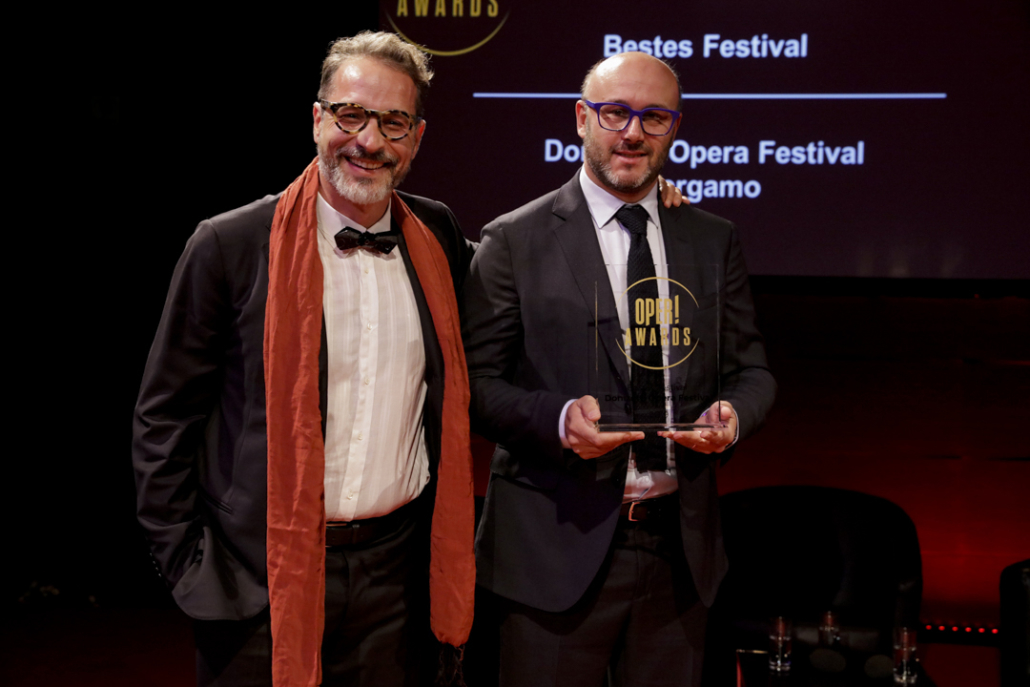
Das traditionsreiche Festival in der Geburtsstadt des Komponisten holt endlich musikologisch, programmatisch und qualitätsmäßig gegenüber der Rossini-Hochburg Pesaro auf. Möglich gemacht hat das der Leiter Francesco Micheli. Und auch der neue Musikchef Riccardo Frizza verspricht einiges. So freuen wir uns schon jetzt im November auf die szenische Weltpremiere der letzten zu entdeckenden Donizetti-Oper L’ange de Nisida.

Honorary Lifetime Achievement

Lebens- und Ehrenpreis / Honorary Lifetime Achievement – Jürgen Rose © Sylvain Guillot

Lebens- und Ehrenpreis / Honorary Lifetime Achievement – Jürgen Rose © Sylvain Guillot

A “Gesamtkunstwerk” spanning an entire life that defies categorisation, an artist who has mastered almost every craft, creating sets, costumes and dramaturgy for more than 300 operas, plays, ballets and operettas, while also working as a director and, in his early days, even as an actor. He achieved his breakthrough at 25 with Cranko’s Romeo and Juliet in Stuttgart; he took his final bow at 76 with Wagner’s Ring in Geneva. He has always hit the mark — a perfectionist and a team player at the same time. For this, he has been loved and feared — and become a stylistic trailblazer for an entire generation of students. Countless images are permanently seared into our memories. For example: the bizarre insect world of The Cunning Little Vixen in Munich. Or Daland’s folded-up, tilted, spinning house in Bayreuth. Thank you for everything, Jürgen Rose.

Lebens- und Ehrenpreis / Honorary Lifetime Achievement: Peter Konwitschny. © Simon Van Rompay

Lebens- und Ehrenpreis / Honorary Lifetime Achievement: Peter Konwitschny. © Simon Van Rompay

To study stage direction, as the son of a conductor and a singer, suggests a certain assertiveness and a zest for debate, but also a close connection to music. Guided by the ideas of Brecht, influenced by Walter Felsenstein and Ruth Berghaus, he has been building bridges to the here and now and to the lived life of audiences since the 1980s, from Handel to Verdi and Wagner to works of the 20th century. With his award-winning productions, he has set new interpretive standards. Contemporary opera and operetta also benefit from his sometimes disturbing, sometimes ruthless, always carefully considered interpretation. He is now also a teacher and a legend, but still full of enthusiasm for the stage: Peter Konwitschny.

© Michel Schnater. Waltraud Meier - LEBENS UND EHRENPREIS

© Michel Schnater. Waltraud Meier – LEBENS UND EHRENPREIS

Waltraud Meier is probably the most famous female Wagner singer since Birgit Nilsson — even though they had only a single part in common. Yet whatever she sang — whether Kundry, Fricka, Ortrud, Sieglinde or Isolde: Waltraud Meier left a deeper impression than any of her contemporaries. Strongly influenced by directors such as Patrice Chéreau and Klaus Michael Grüber, hers was a level of stage presence and dramatic plasticity rarely seen in Wagner operas. Last year, she ended her stage career with a final Klytämnestra.

Among the masters of Early Music, he is the most determined and best opera conductor. Through first editions of works by Cesti and Cavalli as well as catalogue classics from Monteverdi to Handel, René Jacobs began to measure the field of baroque opera, afterwards turning to later periods. He has gone past Beethoven now and recently arrived at Weber’s Freischütz. Along the way, he became the most important contemporary Mozart opera conductor. Curious as ever, he conducted his first Vivaldi opera, Il Giustino, this season, which he had previously refused to do. For this oeuvre, which is still far from complete, we are happy to present him with the OPER! AWARD for his lifetime achievement.

A gnawed chicken leg will hardly cause outrage anymore. The times of scandal are past. But some things can still hit your solar plexus: among them, Hans Neuenfels’ readings of the opera repertoire — ageless, spirited, seamlessly derived from the flow of music and from the sensuous and precise analysis of his material. As could be seen again recently in Vienna, in Neuenfels’ re-staging of Mozart’s Abduction from the Seraglio. Since 1974 he has directed nearly 40 operas, from Rameau to Wagner, from Verdi to Trojahn — each one exactly once. Many of his productions were pathbreaking, all of them were unmistakable.

Das Wunder der Edita Gruberová lag nicht nur begründet in der Strahlkraft und Brillanz ihrer frühen und mittleren Königin der Nacht. Es lag nicht nur an den fulminanten Tudor-Königinnen von Donizetti, denen sie eine ganz neue Relevanz innerhalb des Opern-Repertoires gab. Und es lag auch nicht nur an der Tatsache, dass sie noch mit über 60 Jahren ihre Technik auf eine völlig neue Basis stellte. Sondern dies Wunder bestand darin, dass sie — durch all diese Stationen hindurch — eigentlich immer besser wurde. Dadurch katapultierte sich Edita Gruberová selbst in den Rang einer der wenigen Jahrhundert-Sängerinnen ihrer Zeit.

Best Entrepreneur / Best Benefactor

Bester Entrepreneur / Best Entrepreneur – Christof Loy, Los Paladines © Sylvain Guillot

Bester Entrepreneur / Best Entrepreneur – Christof Loy, Los Paladines © Sylvain Guillot

A German director-turned-entrepreneur champions Spanish intangible cultural heritage and has founded his own company, Los Paladines, for this very purpose. Something unheard of until now. Zarzuela — a kind of Spanish operetta that is, simultaneously, more than and different from its German cousin — inspired him so deeply that he began to study the language, the many traditional dances and the various works of this genre that is so popular in its home country. His goal is to bring the Zarzuela out of its national niche and onto the international stages of the opera world. Why? Because it can easily hold its own against operetta and comic opera. Since 2025, the Madrid-based troupe has been touring central Europe, always directed by this intrepid aficionado, our “Best Entrepreneur”: Christof Loy.

OPER! AWARDS 2025 - François Duplat © Marin Driguez

OPER! AWARDS 2025 – François Duplat © Marin Driguez

First it was pure coincidence, then passion, finally it became a commitment: this is how the now 78-year-old, born in Strasbourg and living in Munich and Paris, looks back on his cinema career. It took him to Germany, to Hollywood and, again and again, back to Paris, to Aix, but also to La Scala in Milan, to Moscow and to Berlin. As the owner of Bel Air Media and Bel Air Classiques, he is responsible for some of the most beautiful opera and dance productions on film — and he is one of the last of his kind. Above all: he keeps on recording even without commission, for example the growing oeuvre of Dmitri Tcherniakov. The businessman as patron, our best sponsor for 2025: François Duplat.

© Michel Schnater. Mitglied der Stiftung der Royal Opera of Versailles, BESTER FÖRDERER, mit Kai Luehrs-Kaiser, Mitglied der Jury.

© Michel Schnater. Mitglied der Stiftung der Royal Opera of Versailles, BESTER FÖRDERER, mit Kai Luehrs-Kaiser, Mitglied der Jury.

“We don’t do it to make money, but to spend money.” These are the words of Laurent Brunner, General Manager and artistic Director of the Royal Opera of Versailles. The foundation, which was set up only in 2021, has since drawn the attention not only of the opera world, but of classical music as a whole, bringing a once-central venue for early music into focus again, after many years during which it operated mostly as a commercial tourist hotspot: by making music again at the original locations of the Opéra Royal and the Chapelle Royale de Versailles. Respect!

OPER! AWARDS 2023, Juror Björn Woll mit Preisträgerin Oksana Lyniv

OPER! AWARDS 2023, Juror Björn Woll mit Preisträgerin Oksana Lyniv

She was the first female conductor at the Bayreuth Festival and the first woman to lead an Italian opera orchestra: these accomplishments have made Oksana Lyniv a role model for a young generation of optimistic female conductors. But she is also a role model for her civic engagement in the face of Putin’s brutal war of aggression against her home country: she is tireless in her commitment to young musicians in Ukraine and she labours to save Ukrainian culture from Russian usurpation. With her music and her engagement, she offers a special contribution to give hope and strength to the people in her homeland.

Von Normalität im Opernbetrieb konnte 2020 keine Rede sein. Wann immer Werke in halbwegs originaler Besetzung und Länge zur Aufführung kommen konnten, war dies der engen Zusammenarbeit mit der Wissenschaft zu verdanken. Durch die unentgeltliche Zurverfügungstellung von Corona-Tests haben Unternehmen wie das Syntheselabor TIB MOLBIOL in Berlin oder die Biotech-Firma Centogene Unmögliches möglich gemacht: Trotz Pandemie konnten so selbst Großprojekte wie die Walküre-Produktion der Deutschen Oper Berlin oder die Konzert- und Aufnahmeaktivitäten der Cappella Aquileia bei den Heidenheimer Opernfestspielen stattfinden.

There was nothing normal about the 2020 opera season. Whenever some works could be performed with their more or less original cast and uncut, it was due to a close cooperation with science. Providing Covid-testing free of charge, businesses like TIB MOLBIOL Laboratories or Centogene made the impossible possible: despite the pandemic, even large-scale projects could take place, for example Die Walküre at Deutsche Oper Berlin or the concert and recording programme of Cappella Aquileia as part of the Heidenheim Opera Festival.

Was kann ein Einzelner schon bewirken? Sehr viel, muss man sagen, wenn man sich anschaut und vor allem anhört, was mit dem Stiftungsvermögen der umtriebigen Nicole Bru mittlerweile erreicht wurde. In einzigartiger Fülle graben die emsigen Mitarbeiter in den Archiven und befördern dabei stetig Werke mit Seltenheitswert ans Tageslicht, die dann in vorbildlichen CD-Editionen in Buchformat erscheinen. Derart viel Engagement ist selten geworden — und daher absolut preiswürdig.

Biggest Nuisance

Even before the new director of the Bühne Baden could take office, it was announced that his orchestra — the last true operetta orchestra in Austria — would be disbanded. In its stead, the Tonkünstler Orchestra of Lower Austria (which has little experience in musical theatre) will play at the Jubiläumstheater and the Sommerarena. Public protests have fallen on deaf ears, politicians remain stubborn. Consequently, the last original operetta stage is being robbed of its backbone — indeed, its musical soul. Now, only the seasonal orchestra of the Lehár Festival in Bad Ischl remains in Austria. Meanwhile, a look toward Germany shows how specialised companies of this kind, such as the Staatsoperette Dresden and the Musikalische Komödie Leipzig, are flourishing. The abolition of the operetta orchestra of the Bühne Baden is the “Nuisance of the Year”.

Cancelled premieres for the current season; shameful equivocation over the financing of the renovation of the Komische Oper, after work had already started; on top of that, disrespectful treatment of institutions entrusted to them; even incitement of apparent social conflicts by the Governing Mayor Kai Wegner (CDU), playing off the “supermarket cashier” who is supposedly uninterested in opera against the supposedly well-off “educated bourgeois”. It is sad to look at the mess Berlin’s centre-right / centre-left government has made of the culture sector. This, despite the fact that culture is one of the few selling propositions the capital enjoys, which is otherwise losing its appeal. That is why the raspberry of the year goes to Berlin and its helplessly flailing Senator for Culture, Joe Chialo (CDU).

Musical theatres are subsidised safe spaces that are allowed to push the envelope. To be politically incorrect. To put their fingers in the wound. That are supposed to tell uncomfortable truths, not subject to purely commercial imperatives. Spaces that should surprise us. So why are the opera houses in so many places so indolent, so predictable, so well-behaved, so timid? Is it the tight financial situation after the pandemic? Have we lost our debating culture because of increasing intolerance? Where are the Ukrainian flags? Where are the flags for Israel? Our wish: Be daring!

If you want to attend the opera in Krefeld, you will have to make your way through the local drugs scene. There are dealers on the theatre’s parking deck, its forecourt is a refuge for the town’s homeless addicts, with all the attendant issues: violence, desperation, destruction, rubbish, death. In the lingo of the municipal public order department this policy is described as “bundling”. What it means is: “exclude and tick off”. The public cry for help from 530 members of staff of Krefeld Theatre in November went unheard. Already the lockdowns made manifest how remote from the arts this generation of politicians has become who no longer visit theatres, cinemas or concerts, who regard culture merely as an interchangeable form of weekend amusement. In Krefeld, the consequences are stinking to high heaven.

Can you make it through a crisis by burying your head in the sand? Many opera houses, especially at the beginning of the pandemic, seemed to think so. On the one hand, their artistic responses often demonstrated a perplexing lack of imagination; on the other, the treatment meted out to well-respected artists and other, often freelance, opera creatives was quite abysmal. More than just a few of our richly subsidised houses made themselves comfortable in their role of passive victim, demanding just the kind of solidarity from politics and society they denied their freelancers.

Zwei Dinge haben uns in der zurückliegenden Spielzeit gar nicht gefallen: Eine dringend notwendige Neupositionierung der Berliner Lindenoper wird um weitere sieben Jahren hinausgeschoben, weil der dann 82-jährige Daniel Barenboim auch nach jetzt 23 Dienstjahren nicht weichen wollte und man keine Alternative herangezogen hat. Und die Tatsache, dass man in Sippenhaft genommen wurde, die in ihrer Authentizität zweifelhaften, von Assistenten vorgenommenen Inszenierungen des mit Hausarrest belegten Kirill Serebrennikov als Opfer der Unrechtsjustiz des russischen Staates gutzuheißen.